Showing posts with label cosmology. Show all posts

Monday, October 9, 2017

"Real Science" Questions Cosmology

Here's an interesting Popular Science reprint. Those of us who study vortices and toroidal space-time cosmology will especially appreciate Matei Apostolescu's illustrations, particularly the "smooth operator."
[for some reason, all of the images associated with this article have been removed from the internet. hmmm...  I'm inserting a fresh image to replace the ones removed.]


C

osmologists used to think the universe was totally timeless: no beginning, no end. That might sound mind-melting, but it’s easier on the scientific brain than figuring out what a set starting point would mean, let alone when it would be. So some physicists have cooked up alternative cosmological theories that make time’s role seem a little less important. The concepts are as trippy as those black-light posters you had in college. Wait a minute…

Flowers of the multiverse

The main reason some physicists obsess over the beginning of the universe is because so much evidence points to there being one. But what if our universe grooved within an ageless multiverse—like a patch of ground from which countless flowers bloom. In this model, each universe has a big bang and keeps its own time. In the most popular version, each universe might even have its own version of physics too. Infinite possibilities yield infinite results: Some say this theory explains life itself.
We’d have to be extremely lucky for a single big bang to create a universe with the perfect conditions for life as we know it, but if new universes are springing up all the time, it’s no wonder one of those cosmic neighborhoods turned out just like ours. The universes in this garden grow or wither according to their own rules, while the multiverse around them goes on without a beginning or an end. It’s an elegant blend of change and timelessness, a floral brew many cosmologists are still sipping.

The smooth operator

Some variations on the big bang go down a little smoother than the original. In the simplest version, the beginning of time is a sharp point, where everything we currently observe was mashed into a ball of energy smaller than an atom—then burst outward, duh. But what came before? Physicists such as Stephen Hawking tried to restore a kind of timelessness by getting rid of that starting point, imagining a universe with no clear “bang.” You can wind back the clock to the edges of those first moments of existence, but asking what came before would be like asking why you can keep walking north when you get to the North Pole. Time, as we define it, loses its meaning as the universe shrinks down.
It never quite narrows to a single point. But no one has proved physics works like that—yet.
Steady state
The big bang posits that the universe exploded into existence and is still booming outward. So to throw out the bang, you must explain why we can see galaxies shooting off into the distance. In 1948, astronomers Hermann Bondi, Thomas Gold, and Fred Hoyle got around the problem by imagining the universe as a constant display of dazzling fireworks, with new matter bursting into existence everywhere, at every moment. In the steady-state model, it looks like the cosmos is growing, but change is just an illusion, man.
The universe is literally spacing out, yeah, but it’s not because of some single original event. It’s because the universe is constantly creating new matter, and that new matter pushes the older stuff out into the beyond. But the discovery of microwave radiation left over from the big bang during the 1960s cooked this idea—the theory couldn’t explain away that afterglow.

The collision

Why does a big bang have to be a beginning? Paul Steinhardt and collaborators propose that there are bangs bangin’ all the time, as our universe rattles around in a fifth dimension (whoa) our puny minds cannot even perceive. All of space and time as we know it sits on a four-dimensional surface called a brane. Sometimes it collides with another universe’s brane, and the smash creates bursts of energy we know as the big bang—energy still detectable as cosmic background radiation. As the universes move farther and farther apart in the fifth dimension, our cosmos expands. The cycles of collision and separation go on forever in a psychedelic dance. Many cosmologists don’t think we’ll ever find proof of this fifth dimension, but the idea that the big bang isn’t the real beginning has no end in sight.
 This article was originally published in the September/October 2017 Mysteries of Time and Space issue ofPopular Science.
tags: 

Sunday, August 16, 2015

Simplicity Is Not Reductionism

Every once in a while, someone I'm talking with reacts poorly to the very notion that complex concepts should or could be simplified--as if this Simple Explanation blog contributes to "dumbing down" science, philosophy, religion, and metaphysics. "Your theory is nothing but pure fantasy and speculation," I hear them say.

Well, I've got news for them-- All axioms are fundamentally unprovable. This is true in science, in logic, and in math. Fundamental propositions are assumed to be true. All of these axioms are in fact intuitive. So the criticism that the Simple Explanation is intuitive is a false criticism, as the same can be said of all science, logic, and math. According to U.C. Berkeley's Understanding Science website: 

"All of science is based on a few fundamental assumptions that transcend any individual experiment or study." 

Understanding Science goes on to explain that, while the fundamental propositions may be assumptions, they generate testable hypotheses that can verify the assumptions. The Simple Explanation is not unscientific--it verifies its hypotheses through observation and by mining other people's research findings, amply demonstrating its theoretical robustness.

I talked this over with my brother, Bill, the philosopher, and he felt it was very important to explain the difference between "simplicity" and "reductionism." So here goes.

Simplicity is not reductionism. 

Simplicity as I use the term involves stripping away layers of linguistic and cultural particulars to reveal underlying universal patterns. According to the Simple Explanation, once memes are lifted out of their familiar linguistic and cultural expressions, their universal applicability can be readily discerned.

Reductionism, on the other hand, narrows the focus of exploration by pursuing information from smaller and smaller objects, as in the way physicists look for ever smaller particles and wave forms to explain the composition of our universe. Hand in hand with this pursuit is the assumption that an object can be reduced to its tiniest components and that this will reveal its underlying nature.

I'm happy to see that according to wikipedia, Bill and I are not alone in our distrust of reductionism. Apparently reductionism doesn't go over so well with ecologists or systems theorists, because interactive systems can't be described by their smallest objects but must be described in terms of relationships and interactions. From the wiki article on reductionism: "Disciplines such as cybernetics and systems theory embrace a non-reductionist view of science, sometimes going as far as explaining phenomena at a given level of hierarchy in terms of phenomena at a higher level, in a sense, the opposite of a reductionist approach.[24]"


So, while conventional science believes itself to be thoroughly pursuing truth through reductionism, the Simple Explanation would say it is more like they are trying to describe the haystack by counting the number of its molecules. Yes, it is a measurable result, but meaningless.

Again, from wikipedia: "Methodological reductionism is the position that the best scientific strategy is to attempt to reduce explanations to the smallest possible entities. Methodological reductionism would thus hold that the atomic explanation of a substance's boiling point is preferable to the chemical explanation, and that an explanation based on even smaller particles (quarks and leptons, perhaps) would be even better. Methodological reductionism, therefore, is the position that all scientific theories either can or should be reduced to a single super~theory through the process of theoretical reduction.

Here at the Simple Explanation, simplicity means "elegance"--the simplest theory that explains the most evidence. But unlike methodological reductionism, the Simple Explanation does not restrict truth to the tiny.The simplicity pursued by the Simple Explanation is of an entirely different kind--a true theory of everything looks for the underlying reality of our cosmos, irregardless of where it is to be found. 

Monday, July 20, 2015

Could Dark Matter Be the Gnostic "Imitation"?

Last week it occurred to me that the way scientists describe dark matter and what the Tripartite Tractate calls "The Deficiency" sound very much alike. It looks as though a case can be made that an ancient religious document is describing a process that has only recently been scientifically hypothesized. 

Let me try to explain: 

Dark Matter is invisible, but we can see a projection of its assumed location in this false-color representation of light-blue clouds at the center of Galaxy Cluster Abell 1689. 
Image credit: NASA, ESA, D. Coe (NASA Jet Propulsion Laboratory/California Institute of Technology, and Space Telescope Science Institute), N. Benitez (Institute of Astrophysics of Andalusia, Spain), T. Broadhurst (University of the Basque Country, Spain), and H. Ford (Johns Hopkins University)

More about this NASA Hubble Space Telescope image here. 
Scientists now believe that our universe is filled with an invisible type of matter that far outweighs ordinary matter by a ratio of over five to one. According to the European Space Agency's Planck spacecraft census of the composition of the universe, ordinary matter only makes up 4.9 percent of the total, while dark matter makes up 26.8 percent. (The other 68.3 percent is made up of formless energy.) As explained in the Simple Explanation's Dark Matter blog article, dark matter was first hypothesized in the 1930s, but it wasn't until the 1990s that astronomers were able to observe what they take to be dark matter.

Not much is actually known about dark matter, since its presence can only be inferred by its gravitational effect on the light travelling from distant stars and galaxies. Recently, some astronomers have proposed that dark matter may be the source of mysterious gamma rays emanating from a ring around our galactic center. 

According to a 2013 article in Discover Magazine, here is what scientists generally believe about dark matter: it is "the glue that holds together the universe and all its rich diversity," and most dark matter tends to "gather in giant, diffuse clouds." Dark Matter particles could also be lurking in a gigantic, invisible disk near the center of our galaxy, "smashing into each other" creating a "strange type of [gamma] radiation" that is "60 billion times as potent as ordinary yellow light." 

NASA continues to process data that maps dark matter's distribution throughout the universe. The image below shows that dark matter is randomly distributed thoughout the cosmos.
This map shows the oldest light in our universe, as detected with the greatest precision yet by the Planck mission. The ancient light, called the cosmic microwave background, was imprinted on the sky when the universe was 370,000 years old. It shows tiny temperature fluctuations that correspond to regions of slightly different densities, representing the seeds of all future structure: the stars and galaxies of today. By analyzing the light patterns in this map, scientists are fine-tuning what we know about the universe, including its origins, fate and basic components. Image courtesy of ESA and the Planck Collaboration.
Lastly, from wikipedia: "The most widely accepted explanation for these phenomena is that dark matter exists and that it is most probably composed of weakly interacting massive particles (WIMPs) that interact only through gravity and the weak force. Alternative explanations have been proposed, and there is not yet sufficient experimental evidence to determine whether any of them are correct."

That's all that is known about dark matter. Now let's switch hats from cosmologist to philosopher to consider The Imitation.

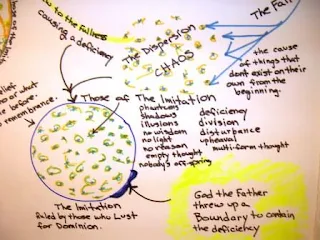
Last month's Gnostic Cosmology blog article explained that our universe was created as the result of a Fall from a state of non-physical spirituality to an initially dark, material state. Below are three illustrations out of the Simple Explanation of Gnostic Cosmology relevant to this discussion. The first poster presents the overall Gnostic Cosmology. The second and third illustrations pertain to the events leading up to the Fall and its consequences:
Gnostic Cosmology according to the Tripartite Tractate, by Cyd Ropp.  Beginning with the Originating Consciousness known as The Father, this diagram starts at the upper left and proceeds clockwise to The Son, then The All, then to the hierarchical arrangement of The All, then to The Fall of the Presumptuous Thought down into the Dark Chaos known as The Imitation. (The remainder of the poster is dealt with in the Gnostic Cosmology article.)

This stage in creation is known as the First Order of Powers. Everyone and everything knows its place and is happy.  The final Aeon to arrive at the top of the pyramid, known in the Tripartite Tractate as "Presumptuous Thought," looks down at the hierarchy and sees them all arranged underneath him. This gives that Aeon the mistaken idea that he is in charge of the pyramid. He reaches upward to reinsert the pyramid into the Metaverse. This is done without authorization, resulting in The Fall.
The Fall tumbles the harmonious arrangement of Aeons into Chaos. They Fall into confusion. They are dispersed and alone for the first time, cut off from each other and the All. This is now called the Deficiency, and the Imitation. Logos panics and abandons the Imitation and retreats back to the All. God the Father also retreats in horror from the Deficiency, which throws up a Boundary containing the Imitation. 


Prior to The Fall, there was no material, only mind. Beginning with undifferentiated consciousness (The Father), mind first became aware (The Son). The Son then differentiated its thoughts and qualities into ALL potential thoughts and ALL potential qualities (The ALL, aka The Fullness, aka The Pleroma). The Fullnesses then named themselves, which automatically sorted them into hierarchical relationships. From this hierarchy of The ALL came the final expression of the Fullness--the final cherry on top of the stack--known in the Tripartite Tractate as "Presumptuous Thought." Presumptuous Thought was a singular entity that combined all the other Fullnesses' qualities into one mind. It was Presumptuous Thought that initiated the Fall from the immaterial plane when it mistook itself for The ALL and acted unilaterally rather than harmoniously.

Now, listen to these descriptions out of the Tripartite Tractate concerning the consequences of "The Fall" of Presumptuous Thought that led to the Creation of our Universe:

"Those who belong to the arrogant thought and those of the likeness are called ... "the Dark Ones"... (98, 15).

"The things he had wished to grasp and reach, however, he produced as shadows, phantoms, and imitations, for he could not bear to look at the light but looked at the depths, and he faltered. Because of this, he suffered a division and a turning away" (77, 11).


"Those who came into being from the presumptuous thought resemble in fact the Fullnesses of whom they are imitations, though they are phantoms, shadows, and illusions, deprived of reason and light, belonging to this empty thought, being nobody's offspring" (78, 28).


"The Word, then, was the cause of these things coming into being, and he became increasingly desperate. He was dumbfounded. Instead of perfection he saw deficiency; instead of unity he saw division; instead of stability he saw disturbance; instead of rest, upheaval" (80, 11).


"Those who had come into being did not know themselves, nor did they know the Fullness from which they had originated, nor did they know him who had become the cause of their existence. For since the Word was in such an unstable condition, he no longer attempted to bring forth offspring in the form of emissions...of glory.... Instead, what he brought forth were feeble and small creatures, infected with the same sicknesses with which he himself had been infected" (80, 15) .


"The imitation that had taken place solitarily in this state was what had been the cause of the things that do not exist of their own from the beginning. In this state he continued to produce such deficient beings, until he began to condemn the irrational things he had produced" (81,2).


Perhaps the production of the "Dark Ones" of the Imitation was the initial cosmological event that kicked off the Big Bang. These Dark Ones, these "shadows," had "no reason," no "light." Instead of the perfection of the hierarchical arrangements, these Dark Ones came "into being" in a state of "chaos." Rather than acting in unity, these Dark Ones manifest "division," "disturbance," "upheaval." These Dark Ones did not resemble the "glory" of the Fullness, but were feeble and small. 

This is the initial state of Creation according to Gnostic cosmology. No light, chaotic, no life, no rules. Filled with feeble, small things, isolated from one another and alone. You could easily call them WIMPS (weakly interacting massive particles). These Dark Ones/WIMPS did not lack the information inherent in ordinary matter, but they were unable to organize themselves the way normal matter does, because they did not possess the spirit of cooperation, coming into being as they did out of a solitary act. 

The Tripartite Tractate goes on to describe how this was only step one in creation, with a quick adjustment that halted production of the Dark Ones until a more "reasonable" form of matter could be produced that combined light with matter, leading to the eventual redemption of matter by mind and spirit...  But that's another article for another day....

Lastly, by borrowing information from the unlikely source of an ancient wisdom book that lay buried under Egyptian sand for almost 2,000 years, we can generate a scientific prediction that will prove or disprove a measureable hypothesis. This Gnostic creation story claims that the first material objects in our universe were dark matter. Light and ordinary matter followed some time later and began a never-ending dance with dark matter. The Simple Explanation predicts that scientists will be able to prove that dark matter was the initial material product of the early universe. You heard it here first.

Sunday, July 12, 2015

A Simple Explanation of Dark Matter

Up until recently, it was thought that there was only one kind of matter in the universe. Sure, it came in many forms (liquid, solid, gaseous, and plasma), but everyone agreed that matter consisted of atoms that behaved in predictable ways. For instance, when you shine a light on matter, you can see it.

Then Dark Matter was discovered. Dark Matter doesn't interact with ordinary matter or light. It can't be seen directly. Its presence is inferred by its visible gravitational influences across a very large scale (light bends to go around a gigantic, invisible, heavy, object). 

It turns out that ordinary matter only makes up 4.9 percent of the total matter in the universe. Scientists now believe that Dark Matter accounts for 26.8 percent of the total. In other words, there is about five times as much invisible, Dark Matter around us as ordinary matter.

The existence of Dark Matter was hypothesized back in the 1930s to answer the question: given the speed that galaxies rotate, why don't their stars go flying off into space? What holds galaxies together? The calculated mass of the galaxies' stars was nowhere near heavy enough to hold a galaxy together. Something extremely heavy--massive--had to be sitting right in the middle of every galaxy, using its gravity to hold the rotating stars in place.

Here's what NASA says about the image above:

ABOUT THIS IMAGE:


This Hubble Space Telescope composite image shows a ghostly "ring" of dark matter in the galaxy cluster Cl 0024+17.
The ring-like structure is evident in the blue map of the cluster's dark matter distribution. The map is superimposed on a Hubble image of the cluster. The ring is one of the strongest pieces of evidence to date for the existence of dark matter, an unknown substance that pervades the universe.
The map was derived from Hubble observations of how the gravity of the cluster Cl 0024+17 distorts the light of more distant galaxies, an optical illusion called gravitational lensing. Although astronomers cannot see dark matter, they can infer its existence by mapping the distorted shapes of the background galaxies. The mapping also shows how dark matter is distributed in the cluster.
Astronomers suggest that the dark-matter ring was produced from a collision between two gigantic clusters.
Dark matter makes up the bulk of the universe's material and is believed to make up the underlying structure of the cosmos.
The Hubble observations were taken in November 2004 by the Advanced Camera for Surveys (ACS). Thanks to the exquisite resolution of the ACS, astronomers saw the detailed cobweb tracery of gravitational lensing in the cluster.
Object Names: CL0024+17, ZwCl 0024+1652
Image Type: Astronomical
Credit: NASAESA, M.J. Jee and H. Ford (Johns Hopkins University)
************************
Readers of the Simple Explanation blog no doubt recognize the lovely torus shape assumed by the Dark Matter "ring." The Simple Explanation's cosmology predicts there will be a ring shape associated with every galaxy's center, as well as a ring shape around just about every other object in the universe. The Simple Explanation suggests that the torus shapes predate and are the cause of the galaxies' formation, not vice versa as most astronomers theorize.


Saturday, September 6, 2014

Laniakea Supercluster New Home for Milky Way

Look at how beautiful this imagery is for the latest ginormous bubble discovered in our neck of the universe. Looks a lot like a giant breast with milk ducts, doesn't it? Gives another meaning to "milky way."
According to the Simple Explanation's story of creation, there are torus-shaped eddies of gravity and energy scattered throughout the universe, ranging in size from tiny to gigantic. This Laniakea would be one such example of a giant vortex that grabbed interstellar particles from the earliest expansion and pulled them into this local system. The toroidal vortex for this large system can be seen on the surface.

Here's a short animation of the cluster provided by nature video. It's stunning!
Below is a graph of the stellar material distributed throughout Laniakea. Now you can see how the matter was attracted to this region by the gravity well at the middle of its torus shape. There are also other gravity vortices scattered throughout, which cause galaxies to form.

According to James Cave's article in Huffington Post (9/5/14), 

"Until now, the Milky Way was believed to be one galaxy in the 2,000 that make up what's known as the Virgo "supercluster." But as the new map shows, the Milky Way's 100 billion stars are actually part of something 100 times bigger: a supercluster of galaxies astronomers have christened Laniakea, meaning "immense heavens" in the Hawaiian language.
Laniakea spans some 520 million light-years across. As you might imagine, all those stars contain a lot of mass. In fact, astronomers say the supercluster is as massive as 100 million billion suns.
How was this supercluster discovered? Researchers used an algorithm to translate the velocities of 8,000 galaxies that surround the Milky Way to show where they are in relation to one another and also how gravity from areas of dark matter causes them to move."

Thursday, September 5, 2013

Alignment of Planetary Nebulae Puzzles Scientists

Couldn't pass this one by without comment. Here is the beginning of an article posted at Space.com.
***************************************

Planetary Nebula Alignment Has Astronomers Scratching Their Heads


Space.com  |  By Mike Wall Posted:
Dying stars that are among the most beautiful objects in the universe tend to line up across the night sky, and astronomers aren't sure why. These "cosmic butterflies" — actually a certain type of planetary nebula — all have their own formation histories, and they don't interact with each other. But something is apparently making them dance in step, scientists using NASA's Hubble Space Telescope and the European Southern Observatory's New Technology Telescope (NTT) have discovered.
"This really is a surprising find and, if it holds true, a very important one,"study lead author Bryan Rees, of the University of Manchester in the United Kingdom, said in a statement. "Many of these ghostly butterflies appear to have their long axes aligned along the plane of our galaxy. By using images from both Hubble and the NTT we could get a really good view of these objects, so we could study them in great detail."
This mosaic shows a selection of stunning images of bipolar planetary nebulae taken by Hubble. Row 1 (from upper left): NGC 6302, NGC 6881, NGC 5189 Row 2 (from lower left) : M2-9, Hen 3-1475, Hubble 5.
***********************************************
Okay, the first thing I see is a stunning array of toroidal vortices at galactic scale. Is it too controversial to suggest that large-scale, unseen, bi-polar electromagnetic and gravitational forces caused material to array itself into these vortices? The article says that what puzzles the scientists is not necessarily the presence of these vortices, but the fact that they are arrayed along the same axes, no matter their location. The study's lead author notes that these axes also align with the plane of our Milky Way, and he is puzzled by this, as well, as our Milky Way has no interaction with these far-away nebulae.

Scientists have discovered that the long axes of bi-polar planetary nebulae align with the plane of the Milky Way. The plane in the illustration above should be tilted like this / to portray it accurately in space.
The Simple Explanation cosmological theory suggests that our universe is brimming with fractal toroidal forces at various scales, from the tiniest sub-atomic particles to the largest cosmic phenomena.

The Simple Explanation's version of the Big Bang envisions the prototype of all toruses actually enveloping and defining the shape of our universe. This toroidal membrane, the originating fractal formula, describes and contains our particular space/time continuum. In this theory, there would indeed be a bi-polar axis through the middle of our universe, with toroidal motion at the farthest edges of our space, sending waves of gravitational influence (for want of a better term) inward toward the middle from the outer 'brane, and waves of expansive energy from the middle outward, feeding universal expansion from the center.  In other words, I predict astronomers will soon find one of these "butterflies" at the middle of our universe.

The Simple Explanation of the alignment of planetary nebulae with our Milky Way galaxy is that all of these objects are aligning themselves with the mother of all "butterfly" vortices at universal center.

Any thoughts?

Wednesday, November 16, 2011

A Simple Cosmology of the Universe

Before the beginning, before space and time, there was nothing but pure consciousness. And consciousness had neither pattern nor form, only awareness.
The Simple Explanation calls the pure consciousness that exists outside our universe the “metaverse.” In the original Greek, “meta” means an idea above and beyond the topic of discussion that brings greater understanding and context to the topic. In this case, the topic is the nature of the universe. In order to better understand our universe, the Simple Explanation begins with that which lies beyond this universe—the metaverse. This metaverse has many names in many traditions—“The Great ‘I AM’” and “God the Father” in the Torah and Bible, “Sat” and “Parambrahma” in Hindu scriptures, the “Tao” and “wu ming” in ancient Chinese texts, and “The Absolute” in modern philosophy.

Then consciousness had a thought which unfolded into countless dimensions. This multi-dimensional metaverse still lacked space and time but it now quivered with limitless mathematical potential. In a twinkling, our entire universe was imagined in the fullness of its complexity, from the tiniest quanta through the greatest astral body; every animal, vegetable, and mineral; every element; everything. At the moment this thought occurred, the metaverse conceived every organizing principle needed to shape and sustain space and time, energy and mass. All was in ideal balance. Every system was theoretically in tune; every function perfectly performed; the consequence of every action anticipated, understood, and plotted to the nth degree. And it was all good.

Once the metaverse formed a particular thought, thought became an object in the great sea of no-thought. Where there was only pure consciousness, now there existed something—thought. In order to preserve the undisturbed tranquility of the metaverse, thought sealed itself off from pure consciousness by focusing inward, and in so doing formed a toroidal-shaped bubble around itself. Where there was only the tranquil nothingness of the metaverse, there was now thought and directed action, initiating sequential time. On this day that time began, consciousness wrapped itself around our universe, forming a border between us and infinity. Mind took on a shape.
The “Shape of God’s mind,” also known as  the “Universal Unit of Consciousness,” the “Womb of Creation,” the “Son of God,” “logos,” “the Word,” the “universal fractal formula.” We can think of this wireframe version of the toroid as the idealized mathematical blueprint imagined by the metaversal consciousness prior to creation.
This toroidal-shaped membrane is composed of conscious thought and its concept of this universe, split off from the unformed metaverse and operating on its own. The Simple Explanation calls this original torus the Universal Unit of Consciousness (Universal UC). The content of its thought is the entire logos of our universe. The Bible puts it this way:“In the beginning was the Word, and the Word was with God, and the Word was God. Logos was in the beginning with God. All things were made through the Word, and without this logos, nothing was made that was made,” (John 1:1).

Which begs the question: How is it possible for an object (our universe) to rest "inside" the formless metaverse without affecting its undifferentiated nature? How can space and non-dimensionality, time and timelessness, change and the changeless co-exist without touching the untouchable metaverse?

This paradox is easily solved by imagining that the toroidal membrane itself possesses a fractal surface akin to the Koch snowflake. As you can see, through endless divisions, the perimeter of the figure becomes infinitely complex and long, while the interior of the 2-dimensional Koch snowflake remains finite and contained to the figure, never reaching "outside."

These are the first four iterations of the Koch snowflake fractal formula. At each computation, a side is divided into three equal segments and an equilateral triangle the length of a segment is placed at the center segment. The center segment’s line is then erased, leaving behind a perimeter that is four times longer than the original side. Even though endless computations may lengthen the perimeter to infinity, the snowflake’s volume remains finite.
Now imagine applying the Koch divisions to the surface of the Universal UC torus, with the divisions facing outside. As the membrane divides toward infinity, the space within remains finite and contained; keeping the undifferentiated unity of the metaverse unsullied. The effect of this infinitely recursive fractal surface can be likened to that of an invisibility force field deployed around our universe, i..e, "What happens in our universe, stays in our universe."

The concentrated thought of the Universal UC focused inward on a singular point of limitless energetic potential—enough to seed our universe. Concentration gave rise to toroidal forces that begat energetic waves. Our universe began to expand outward as energy exploded into the torus of space out of the zero point field at the center. In Sanskrit, “ananda” means both energy and joy. The Simple Explanation suggests that organized consciousness , “chit,” combined with ananda and began emitting the building blocks of our universe.
Shape gives rise to toroidal forces that explode into dimensional space as patterns of energy culminating in material quanta.  Cosmologists refer to this initial energetic event as the Big Bang.
 
As the interior torus of our universe expanded, over and over and over again pale echoes of the Universal UC attached themselves to the particles streaming out of the Big Bang. In Sanskrit, these smallest material quanta are individually known as “anu” and collectively called “maya,” or creation. “Avidya,” Sanskrit for “loss of consciousness” or “delusion,” is a necessary by-product of material instantiation as each individualized point-of-view in time and space replaces universal, non-localized awareness.
The Universal UC pulses with concentration at the birth of every thing in our universe. These pulsations funnel waves of consciousness inward from the border of the Universal UC toward creation, informing each new piece of material with its own unit of consciousness (UC) as it emerges from the universal portal of here and now.

Particles rush into our universe from the zero point field at the center, exploding outward, filling our universe from the middle. The outer fractal membrane presses inward to contain the energy exploding outward. Matter flows outward from the middle, repulsed by the energy streaming into the universe from the center, and coherence presses inward from the outer universal boundary. We experience the repulsive energy as “joy” and excitation, and the containing energy as “love” and security.
This cutaway view of the torus from the top shows ananda/joy exploding outward
and coherence/love pressing in.
This is the point in creation when the Universal UC is traditionally referred to by such names as “God the Creator,” “Shakti,” and the “Mother of 10,000 Things.”

Time passes and creation becomes more complex as subatomic particles reach out to one another according to the principles of organization conceived by the metaverse and set into motion by the Universal UC.

And particles joined to make atoms, atoms to make molecules, molecules to make single-celled organisms. Single-celled organisms diversified into the full panoply of life, and every one of these material building blocks came equipped with its own unit of consciousness (UC). Each unit of consciousness knew what particular role it needed to play in order to help the universe create and sustain itself, for every UC could decode and instantiate its own special piece of the metaversal ideal.


quanta UC
atomic UC
molecular UC
cellular UC
organism UC
societal UC
global UC


At each stage along the way from simple to complex, units of consciousness are increasingly sophisticated in their ability to regulate and manage their existence.

Sustaining Creation requires an uninterrupted stream of organization and intention funneling inward from the border that separates our space and time from the metaverse at large. Like pure potential pouring down the gravitational well of a great black hole, our possible futures become increasingly limited as they funnel toward the crucible of here and now at the heart of creation. Here and now, all potentials collapse as only one course of action is realized.

We generally refer to collapsed potential as “history.” The “future” is uncollapsed potential. There are an infinite number of potential futures that become increasingly constrained as they approach here and now. Here and now is the gateway of singular choice. The arrow of time flows downward through the middle of the torus, past here and now, and emerges into the past as a line of singular history. “Karma” is the consequence of historical choices made in the here and now.

Karma is the mechanism through which the consequences of behavior inform future potential. Karma is a force of influence that arises out of the decision-making history of every unit of consciousness in the universe. Each UC generates its own karma. We are all affected by one another’s karma. The more a unit of consciousness has in common with another UC, the more it is affected by the other’s karma. Our aggregate karma affects all of creation.