Thursday, September 29, 2011

The Rhetoric of Childbirth: The Trial of a California Midwife

In 2001 I was awarded a Ph.D. in Rhetoric from the Department of Communication at the University of Memphis. My dissertation, The Rhetoric of Childbirth: The Trial of a California Midwife, examines the language used by medical experts in the 1997 trial of Abigail Odam, a San Diego midwife who was arrested and convicted of several felony counts of "Practicing Medicine Without a License" for childbirths she assisted with in private homes. 

I've just made the book available on the web as a pdf. You may download it for free from my lulu.com storefront.

This is academic writing at its finest. Definitely not simple. Those of you reading this blog in other countries are probably not aware of the professional schism between physicians and midwives in the United States, typical of the larger divide between conventional Western medicine and traditional/alternative healers.

 Order Paperback

Here is the Abstract:


How one characterizes pregnancy determines how the exigency of birth should be handled.  Should pregnancy be defined as a medical condition as obstetricians would claim, or is childbirth a natural, normal event rarely requiring medical intervention, as midwives would have it?  The testimonies of health care professionals who appeared as witnesses in the case of The People of the State of California v. Abigail Odam were analyzed using Kenneth Burke's dramatistic pentad in order to demonstrate the significant professional demarcation revealed by the discourse, clinical approach, and philosophical worldviews held by adherents of the medical model of birth and traditional midwifery.  Trial testimonies such as these make it possible to see how physicians and midwives describe physiological processes in markedly different ways--the result of differences in perspective arising from very different terministic screens.  The trial also provides a situated example of the state's alliance with conventional philosophy, science, and medicine, and how the lay midwives, who came to the trial as a culturally marginalized profession, were further hampered by the structural imposition of rules of evidence and discourse that tended to undermine their rhetorical style and non-scientific worldview while simultaneously privileging the discourse of physicians.

Friday, September 23, 2011

Communing With the Soul of God

This morning we were reading from The Second Coming of Christ/The Resurrection of the Christ Within You. This book was assembled and edited by the Self Realization Fellowship from numerous writings published by Paramahansa Yogananda during his lifetime (1893-1952).

Paramahansa Yogananda
Yogananda taught his followers a modified Kriya yoga technique of "scientific meditation" as the way to open up intuitive vision and access direct knowledge of "God" or, alternately, "Reality." The following quote from his chapter on Jesus and Nicodemus (John 3:1-8) leads into a discussion of what it means to be "born again":

 "All bona fide revealed religions of the world are based on intuitive knowledge. Each has an exoteric or outer particularity, and an esoteric or inner core. The exoteric aspect is the public image, and includes moral precepts and a body of doctrines, dogmas, dissertations, rules, and customs to guide the general populace of its followers. The esoteric aspect includes methods that focus on actual communion of the soul with God. The exoteric aspect is for the many; the esoteric is for the ardent few. It is the esoteric aspect of religion that leads to intuition, the firsthand knowledge of Reality." (Yogananda, p.240, vol. 1)

According to the Simple Explanation, the exoteric, public image of a religious institution is defined by the memes held by or rejected by that institution. The "moral precepts" and "doctrines, dogmas, dissertations, rules, and customs" are the particular memes and meme chords that define membership in that institution. Many religious meme chords are shared by members of diverse religions. Religions generally share, for example, belief in the overarching "God" meme chord, and generally agree on most of the lesser-included memes that make up the God chord, such as memes concerning God's omniscience and omnipotence, and the importance of communing with God in prayer. Then come the memes religions do not share in common--memes of saints and saviors, histories, and other customary beliefs. The memes they do not share set them apart from each other. 

A Simple Explanation of the esoteric aspect referred to by Paramahansa that focuses on "communion of the soul with God" is that such communion is not of the religious meme-sharing variety, but involves its opposite--meme shedding. When one's grip on habitual thought patterns relaxes, their governing UC intuitively aligns itself with the metaversal principles embodied by the Universal UC. During these brief or extended periods of alignment, "firsthand knowledge of Reality" is glimpsed.
"Glimpsing God" through a toroidal skylight at Sagrada Familia Cathedral.

Exoteric knowledge is often defined as knowledge available to anyone, whereas esoteric knowledge is reserved for the innermost circle of devotees. This definition makes it seem as though true knowledge is being withheld by those in power. Yet, if one adopts the Simple Explanation's definition of meme-based vs. intuitive knowledge, then esoteric knowledge of God is truly available to any and every believer. The only limitation is the believer's own willingness to suspend attachment to their personal meme bundle long enough to allow their UC to align with the Universal UC.

When the memes are set aside, i.e. thought is suspended; language suspended; the person's governing UC remains. This fractal unit of consciousness underlies the memes. Unencumbered by meme attachments, the person's governing UC aligns with the Universal UC. This condition is called "bliss" in Buddhist and Yogic teachings. "Be still and know that I am God" is how the Bible says it (Psalm 46:10). Verse 16 of the Tao Te Ching says, "Be still. Stillness reveals the secrets of eternity," (J. Star translation).

To "be still" is to suspend attachment. Knowing comes during the still point between the pendulum swings of breath and thought. To "be still" is how we hear God. Be still.

Wednesday, September 21, 2011

Process Note: My Birthday

Can't let my birthday go by without blogging. Our season here at the Albion Inn will soon be drawing down as the Oregon Shakespeare Festival season comes to a close. Then I will have plenty of time to philosophize with you here at the Simple Explanation blog.
Franny and Zoey beaking on the bricks in the Albion Inn's rose garden.
Meanwhile, we have had a very pleasant busy season, full of good weather, great theatre, beautiful flowers, and excellent guests. 
Many more fresh blog articles are pending in the notes pile, including updates on how some of us have been putting the Simple Explanation into practice. I'm also going to be turning the articles into a single, cohesive book.

Tell me: would you be more inclined to read a book called "A Simple Explanation of Absolutely Everything," or "A Simple Fractal Model of the Conscious Universe"? Please leave your answer below as a comment if you would. Thank you.

Wednesday, September 7, 2011

Meaning Is In the Memes

The Simple Explanation states that a huge part of our personalities is shaped by the memes we hold dear as well as the memes we hate.
The memes you cling to (sanskara), both the ones you like and ones you don't like, influence your ability to exercise your free will in the here and now. When you unthinkingly lock onto a meme or set of memes, it is your belief in the memes that determines how you will interpret your surroundings and how you will respond. Your response may or may not be the best response to a situation, but it is the only one your set of memes allows.

We see this phenomenon at play every day. For example, a person (person A) whose meme bundle includes a belief that others are "out to get me" will interpret events in a manner that reinforces that meme. The most innocent statements on another's part (person B) will activate person A's "out to get me" meme, even when no such insult was intended. Person A's ego is hurt by their own meme, not by person B.

Another example of delimiting memes occurs during problem-solving. The more tightly held one's memes are, the fewer solutions will present themselves. The ability to consider solutions "outside the box" and to engage in "lateral thinking" comes about through nonattachment to the "shoulds" and "oughts" of how things work. One must be willing to set aside treasured beliefs in order to perceive memes outside one's own bundle and thereby discover fresh solutions.

I realized the other day that each and every cultural institution we belong to (family, workplace, church, mosque, tribe, nation, etc.) not only comes with its own bundle of shared memes held in common by its members, it also comes with a filter that prevents members from acknowledging or adopting incompatible memes. Memes are even more important to an institution than its members in the sense that members come and go, but memes persist.

Institutions are defined as much by their excluded memes as they are by their included memes. An exclusive institution holds tightly to the indentity provided by its memes; its border is strong and its filter powerful. An inclusive institution allows members more latitude in the memes they may hold; its border is less defined; its filter less opaque. An "open-minded" institution acknowledges the fact that there are memes out there in the greater culture that may have value, and is willing to consider new memes; its border is permeable and its filter thin.

A goal of the Simple Explanation is to demonstrate the simple commonality of the reality underlying the panoply of memes. Not just the religious memes; not just the spiritual memes; but the "rational" and "scientific" memes, too.

Wednesday, August 17, 2011

Fractal Yarrow Flower

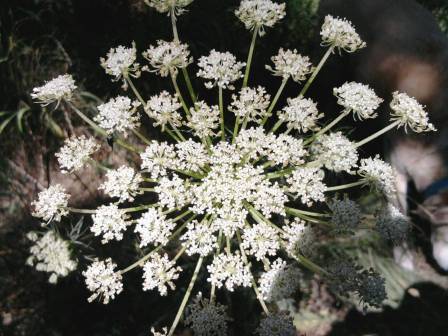
The yarrow flowers are abundant this year, due to an especially late spring and late, heavy rains. Yesterday, when I was out walking the dogs, I noticed how beautifully fractal the yarrow flowers are. Looking at the largest flowerhead shape here as the first level, you can easily see two fractal levels down from there--the florets within the flower have florets of their own. Here's the picture I took with my cell phone.
Notice how fractal the yarrow flower is
When I look at this outwardly bursting, fractal pattern I am reminded of ananda-joy energy exploding outward into our space-time continuum from the center of here and now.

Ananda-joy energy bursting outward into our space-time continuum manifests at the next fractal level up as the smallest level of material quanta (anu). The Simple Explanation proposes that a unit of consciousness (UC) is associated with every manifested thing, from quanta on up.
When the inward-poking forces wrap around from the outside and slide into the vortex, they wind up poking outward from the center in an explosive pattern. You can read more about toroidal flow here.
Here is what the yarrow flower looks like before it unfurls. All the florets are turned inward, facing the inside.
Can you see how the inside of the yarrow resembles the illustration above of toroidal flow? On the outside, you can see only the stems, looking very much like meme strings wrapped around a UC.
I am also reminded of "falling backward" into smaller and smaller fractal calculations until the pattern of the yarrow flower becomes the pattern of the molecules and the atoms and the sub-atomic particles fractally nesting until not even their wave forms remain to disturb the singularity of pure consciousness.
 *********
At the beginning of this article I identified three fractal levels of one repetitive pattern that makes up the yarrow flower. Here are a couple of more pictures that demonstrate two more fractal levels up from the flower. Looking at the entire plant, you can see that each yarrow flower is to the plant as each floret is to the flower. One level up from there, you can see that each yarrow plant is to the field as each flower is to the plant, as each floret is to the flower, as each tiny floret is to the larger floret...
Yarrow flower
Yarrow plant
Yarrow field

Monday, August 8, 2011

Toroids and Trees

Almost every day I walk with my dogs in a small woods that runs alongside a canyon creek near our inn. Over the past three years, I've become very fond of these woods, the little creek, and the tiny waterfall that marks our turnaround point. 
Franny and Zoey at Oredson-Todd Woods in Ashland, OR

Since writing the Simple Explanation, I've been noticing toroids in the trees. Look--
Tree Torus
My cell-phone photos do not do justice to this sensuous, rounded tree torus. Each tree has a torus wherever a branch existed and exists no more. When the branch goes away, the tree's skin fills in and rounds out the hollow.

For that matter, the torus is there from the beginning of the branch, as well. You could say that the branch emerges out of the torus form, like a stick poking out through a donut. It is difficult to observe this at the formative stage, but you can see how it happened in retrospect, by examining a branch in the process of going away.

In the photo above, you see a dead branch on its way out, emerging out of the torus in the wall of a fallen tree. Had this been a live tree, the skin would have grown back around the hole left behind after the branch stump finally fell out, forming the torus shape in the earlier photo.

Tree in process of reforming a torus shape around a sawn-off limb.
In the same manner that the Simple Explanation suggests each of our organs has "a mind of its own" with its own governing UC attached to it, so each tree branch is a separate and distinct entity, a fractal of the mother tree. Each branch as a job to do, to follow the sun and gain nourishment from the rain and sky, in order to contribute to the tree's greater good. When it is no longer able to do its job, the branch withdraws into its original torus shape from which it emerged.


Tuesday, July 19, 2011

Lisi's "Exceptionally Simple Theory of Everything"

A comment by one of our Anonymous readers last week invited me to read the Wikipedia article called "An Exceptionally Simple Theory of Everything," which concerns a physical theory of everything (TOE) recently proposed by Garrett Lisi et. al. Naturally, the similarity between the title of that theory and the Simple Explanation's title piqued my curiosity. I have now read the Wiki article and have also followed and read various html links leading out from that article. While I don't pretend to understand all of the physics, from what I can tell so far, their theory is possibly compatible with the Simple Explanation's toroidal model.

Look at these images from the wiki article.  Here we see Lisi's breakdown of the hierarchical levels of matter.

Levels of magnification:
1. Macroscopic level - Matter
2. Molecular level
3. Atomic level - Protons, neutrons, and electrons
4. Subatomic level - Electron
5. Subatomic level - Quarks
6. E8
[Click here to read this blog's Simple Explanation article on hierarchies of matter and their relationship to consciousness.]

At the smallest level of instantiation, Lisi proposes this "most beautiful" geometric figure, called E8.

Diagram of E8

Interesting how this view of E8 so resembles a topside view of our Simple Explanation's familiar wireframe torus. Beyond the similarity in names, both Simple theories propose a single mechanism that unites the four fundamental forces into one singular protoforce.

 The figure below is another view of E8. Click on the caption to see a most amazing dynamic view of E8 in rotation, hosted at wikipedia commons.


Rotation of the E8 root system in eight dimensions, with particle assignments corresponding to gravitational, electroweak, and strong charges

 Later, when I have more time, I may attempt a Simple Explanation of "An Exceptionally Simple Theory of Everything."  In the meantime, this Scientific American article where Lisi defends his Theory is an interesting read.

Friday, June 24, 2011

Bagel-shaped Protons

I'm sorry I haven't been able to write much lately. This is our busy season here at the Albion Inn and my innkeeping duties prevent me from sitting at the computer long enough to get an article out. But every once in a while we have a guest here at the inn that somehow furthers the Simple Explanation along, either through discussions with me, or through some other means.

We had a physics professor staying here at the Albion Inn last week. He and his wife were amused to see the torus on my Simple Explanation business card. It happens to be the same torus drawing as the illustration below. Turns out this professor, Gerald Miller, demonstrated back in 2003 that some protons are toroidal. The others, he said, were spherical. I asked him if it was possible that the spherical protons were actually toroidal. He said, "no." But then I asked him if the spherical protons might not look spherical on the outside, but possess toroidal flow energies within their borders. He said, "yes, that could be the case."

Here's a short article from the online Discover Magazine about it:

Discover Magazine,What Shape Are Your Protons?

by Kathy A. Svitil


In the subatomic world, nothing is simple. Take the proton, a fundamental particle found in the nucleus of every atom. For decades, students have been taught to picture the proton as a nice round ball, like a miniature planet. But no: The latest computer simulations show the particles can resemble peanuts, beehives, even bagels.


The three faces of a proton: sphere, peanut, and bagel.

Graphics courtesy of Gerald Miller/University of Washington (3).

Protons are complicated because they are composites of three smaller bits, called quarks, that zip around inside at roughly half the speed of light. "Quarks cannot escape from the proton. When they come to a wall, they turn around and change their direction," says theoretical physicist Gerald Miller of the University of Washington. Bouncing around gives the proton a net angular momentum. Using a mathematical model based on studies from particle accelerators, Miller showed how a proton's internal momentum affects its shape. Fast quarks that spin in the same direction as the overall proton distort it into a peanut, while quarks that have opposite spin breed bagels. Proton shape-shifting probably influences subatomic interactions in ways that are not yet known. Nobody understands exactly how the momentum inside a proton keeps changing. "All we can say is that sometimes it is large and sometimes small, and every proton can fluctuate instantly from one shape to another," Miller says.

I just love how the universe brings all good things to me. Even our guests are special.

Monday, June 13, 2011

A Simple Explanation of Jellyfish

Box Jellyfish photo and related article posted at SciNewsBlog
The New York Times ran an article last Tuesday (June 7, 2011) on jellyfish entitled, "So Much More Than Plasma and Poison." Here's a quote from that article:

A diverse group of thousands of species of gooey, saclike invertebrates found throughout the world, the jellyfish are preposterously ancient, dating back 600 million to 700 million years or longer. That’s roughly twice as old as the earliest bony fish and insects, three times the age of the first dinosaurs.
“Jellyfish are the most ancient multiorgan animal on earth,” said David J. Albert, a jellyfish expert at the Roscoe Bay Marine Biological Laboratory in Vancouver, British Columbia.

The New York Times article goes on to cite several recent studies of jellyfish that disprove old assumptions. Contrary to earlier belief, jellyfish are not brainless, thoughtless lumps of protoplasm. Box jellyfish, for example, have eyes very much like human eyes, mounted on gyroscopic stalks that allow them to stare upward and out of the water for active shoreline navigation. Another study of jellyfish concludes that, although their neurons are distributed diffusely and not concentrated into a brain, jellyfish do nevertheless perform complex behaviors well beyond simple reflex. Please take a look at the nine-picture slideshow that accompanies the New York Times article by clicking on this NYT link, The Complexity of Jellyfish. Believe me, it's worth the look!

Here's what comes to my mind when I look at these photos of jellyfish--swimming toroids!

Here; watch the following short youtube video of bioluminescent jellyfish and see swimming, glowing toroids for yourself. It's quite beautiful.


Now here's the absurdly Simple Explanation of what we are seeing:

Jellyfish are the purest expression of the manifested toroidal pattern at the multi-organed animal level.

It's as if the first pattern that our ancient governing units of consciousness attempted was the pattern most familiar to them: the toroid.
The toroidal pattern seems to have been a very good choice; jellyfish have survived for at least 600 million years and passed unscathed through five global waves of mass extinction. Jellyfish were populating the planet well before vegetation evolved on land! According to the NYT article, jellyfish are twice as old as bony fish and insects, and three times older than the earliest dinosaurs. With that much jellyfish time, chances are good that there have been an enormous number of jellyfish UCs.

There is even one type of jellyfish, turritopsis nutricula, that appears to be immortal. Through a process called transdifferentiation, this creature is able to cycle from polyp to adult to aged and back to polyp again in an unending cycle of regeneration.
Turritopsis nutricula, the immortal jellyfish
Simple Explanation's diagram of memes and karma encycling an individual's UC.

Since reading about jellyfish and seeing these pictures of them, I've been doing a little jellyfish qigong in the morning that you may like to try:

Standing comfortably, arms relaxed at sides, chin down, eyes closed. Breathing in slowly, imagining myself a jellyfish breathing in ocean water and bouying up, floating effortlessly in the sea. Feeling light, swaying in the currents.  Then exhale the air, exhale the ocean water, coasting along in the current of sea, relaxing. Resting lightly, the legs and arms, the tentacles,hanging loose.  Repeat.

Peace. 

Wednesday, June 1, 2011

Toroidal Patterns in Fruit

I love seeing the toroidal patterns in the fruits and vegetables as I prepare them for salads. Here are a few pictures from my kitchen that clearly illustrate how the toroidal flow imprints itself upon fruit.

Could this apple resemble the torus any more closely?

The Simple Explanation's basic toroidal forces: yellow arrows = love, coherence, gravity pressing inward; white arrows cycle around the outside, up, over, and straight down through the center = constantly recycling protoenergy, karma; arrows out from the middle = ananda, joy, expansion, energetic and material manifestation into our apparent universe. 

This is the toroidal pattern of creation, fractally replicating as an apple. The straight stem follows the pattern of the toroidal pole. The skin takes the shape of the outside of the torus, wrapping over the lip and falling into the gravity well of the stem. The seed explosion at the middle resembles the ananda/joy point of individual manifestation, carrying forward the next iteration of fractal expressions of the torus.

Top view of apple showing the outside flow pattern of the torus, as lines loop from pole to pole and then over the top hump and down into the center. The toroidal pole comes straight up the middle.
Top view of the most basic energetic patterns of creation. This is a top view of the Simple Explanation toroidal forces diagram above.
 A few days ago I was moved to photograph these cherry tomatoes as I was preparing them for an omelet.

The first thing that struck me was the impression of the Tree of Life in the tomato half, like a sparkling little diorama of a tree and its roots.

Cherry tomato tree of life
Next I was struck by the perfect torus shape.
The cherry tomato is a fractal iteration of the universal toroidal fractal.
(the following section has been relocated from the "stay centered" article.)

Oftentimes, matter can be seen as an allegorical expression of idealistic patterns. I recently noticed even more similarities between this toroidal model and the seed patterns in fruit.
The star of seeds inside a pear is like particles pouring out of the big bang.

The star of seeds at the center of the pear expresses the fractal formula of the pear.
Behold the UC as expressed by the pear. You can see the dynamic energy of both vitality and information exploding from the center of the pear as a starburst of seeds. The center point of the toroid expresses both energy and joy and it bursts forth into our universe. The patterns at the center of the fruit are fractally true. The center is life and truth. It is the center from which the metaversal pattern emerges. Near the seeds we see an area of denser nutrients (the intense yellow of the bottom photo). This area can be thought of as the sustenance of our immediate surroundings, placed there by the Universal UC for our use and care. The meaty area outside that is what I think of as somewhat removed from the middle, as consciousness looking outward rather than inward. There are no metaversal seeds out there. Finally, we can see the skin containing this pear, holding it separate, sealing it off, protecting and constraining.


The star of seeds, ananda/joy, exploding from the middle. Love/coherence pressing inward from the skin. A UC made manifest.


On another note, this morning when I opened the Albion Inn's refrigerator, I was greeted by this charming watermelon.

The outside of this watermelon reminds me of the Simple Explanation's model of memes shrouding UCs, wrapping around the torus shape from pole to pole and back again through the middle:

toroidal pattern on the watermelon's skin