Sunday, April 25, 2021

Our Lovely Milky Way Torus

 Here is a new NASA image of the lovely torus that is our galaxy--

STARS WITH A VIEW  Two newly discovered clusters of stars lie far from the Milky Way’s spiral arms. Planets orbiting these stars might get this view of the galaxy in all its spiraling glory.

R. HURT/ESO/JPL-CALTECH/NASA

Saturday, February 27, 2021

A Simple Explanation of Gaia Hypothesis--Plus Nautilus Article Reprint

 One of the basic propositions of A Simple Explanation of Absolutely Everything is what I call the Simple Golden Rule--everything, no matter the scale, reaches out to others and "holds hands" to create something larger than itself that can only come about through cooperation with others. 

In the diagram below, you can see how everything "levels up" to contribute to larger and larger structures. Up near the top of the diagram, we reach the global or "Gaia" scale of organization and consciousness.


In this article reprint, from his 2016 book Earth In Human Hands, David Grinspoon lays out his observation that all planets in the Universe will be either fully alive and teeming with life, or fully dead and devoid of life. Grinspoon presents an explanation of the Gaia hypothesis that links lifeforms and minerals in a synergistic dance that requires us to think of the Earth as a living form. I am reprinting this article from Nautilus Cosmos so that you can see how the Simple Explanation's "building upward" orientation contributes to the Gaia hypothesis.

*********************************************************************************

Why Most Planets Will Either Be Lush or Dead

BY DAVID GRINSPOON JANUARY 12, 2017

Can a planet be alive? Lynn Margulis, a giant of late 20th-century biology, who had an incandescent intellect that veered toward the unorthodox, thought so. She and chemist James Lovelock together theorized that life must be a planet-altering phenomenon and the distinction between the “living” and “nonliving” parts of Earth is not as clear-cut as we think. Many members of the scientific community derided their theory, called the Gaia hypothesis, as pseudoscience, and questioned their scientific integrity. But now Margulis and Lovelock may have their revenge. Recent scientific discoveries are giving us reason to take this hypothesis more seriously. At its core is an insight about the relationship between planets and life that has changed our understanding of both, and is shaping how we look for life on other worlds.

Studying Earth’s global biosphere together, Margulis and Lovelock realized that it has some of the properties of a life form. It seems to display “homeostasis,” or selfregulation. Many of Earth’s lifesustaining qualities exhibit remarkable stability. The temperature range of the climate; the oxygen content of the atmosphere; the pH, chemistry, and salinity of the ocean—all these are biologically mediated. All have, for hundreds of millions of years, stayed within a range where life can thrive. Lovelock and Margulis surmised that the totality of life is interacting with its environments in ways that regulate these global qualities. They recognized that Earth is, in a sense, a living organism. Lovelock named this creature Gaia.

Margulis and Lovelock showed that the Darwinian picture of biological evolution is incomplete. Darwin identified the mechanism by which life adapts due to changes in the environment, and thus allowed us to see that all life on Earth is a continuum, a proliferation, a genetic diaspora from a common root. In the Darwinian view, Earth was essentially a stage with a series of changing backdrops to which life had to adjust. Yet, what or who was changing the sets? Margulis and Lovelock proposed that the drama of life does not unfold on the stage of a dead Earth, but that, rather, the stage itself is animated, part of a larger living entity, Gaia, composed of the biosphere together with the “nonliving” components that shape, respond to, and cycle through the biota of Earth. Yes, life adapts to environmental change, shaping itself through natural selection. Yet life also pushes back and changes the environment, alters the planet. This is now as obvious as the air you are breathing, which has been oxygenated by life. So evolution is not a series of adaptations to inanimate events, but a system of feedbacks, an exchange. Life has not simply molded itself to the shifting contours of a dynamic Earth. Rather, life and Earth have shaped each other as they’ve co-evolved. When you start looking at the planet in this way, then you see coral reefs, limestone cliffs, deltas, bogs, and islands of bat guano as parts of this larger animated entity. You realize that the entire skin of Earth, and its depths as well, are indeed alive.

The acceptance of the Gaia hypothesis was, and remains, slow, halting, and incomplete. There are several reasons for this. One is just the usual inertia, the standard conservative reluctance to accept new ways of thinking. Yet Gaia was also accused of being vague and shifting. Some complained that the “Gaians” had failed to present an original, welldefined, testable scientific proposition. How can you evaluate, oppose, or embrace an idea that is not clearly stated, or that seems to mean different things to different people? There was certainly some truth to this. Gaia has been stated many different ways. Also, it didn’t help that Margulis and Lovelock were more than willing to mix science with philosophy and poetry, and they didn’t mind controversy; in fact, I’d say they enjoyed and courted it.

The truth is, despite its widespread moniker, Gaia is not really a hypothesis. It’s a perspective, an approach from within which to pursue the science of life on a planet, a living planet, which is not the same as a planet with life on it—that’s really the point, simple but profound. Because life is not a minor afterthought on an already functioning Earth, but an integral part of the planet’s evolution and behavior. Over the last few decades, the Gaians have pretty much won the battle. The opposition never actually surrendered or admitted defeat, but mainstream earth science has dropped its disciplinary shields and joined forces with chemistry, climatology, theoretical biology, and several other “ologies” and renamed itself “earth system science.”

The Gaia approach, prompted by the space-age comparison of Earth with its apparently lifeless neighbors, has led to a deepening realization of how thoroughly altered our planet is by its inhabitants. When we compare the life story of Earth to that of its siblings, we see that very early on in its development, as soon as the sterilizing impact rain subsided so that life could get a toehold, Earth started down a different path. Ever since that juncture, life and Earth have been co-evolving in a continuing dance.

As we’ve studied Earth with space-age tools, seen her whole from a distance, drilled the depths of the ocean floor, and, with the magic glasses of multispectral imaging, mapped the global biogeochemical cycles of elements, nutrients, and energy, we’ve learned that life’s influence is more profound and pervasive than we ever suspected.

All this oxygen we take for granted is the byproduct of life intervening in our planet’s geochemical cycles: harvesting solar energy to split water molecules, keeping the hydrogen atoms and reacting them with CO2 to make organic food and body parts, but spitting the oxygen back out. In Earth’s upper atmosphere some of this oxygen, under the influence of ultraviolet light, is transformed into ozone, O3, which shields Earth’s surface from deadly ultraviolet, making the land surface habitable. When it appeared, this shield allowed life to leave the ocean and the continents to become green with forests. That’s right: It was life that rendered the once deadly continents habitable for life.

The more we look through a Gaian lens, the more we see that nearly every aspect of our planet has been biologically distorted beyond recognition. Earth’s rocks contain more than 4,000 different minerals (the crystalline molecules that make up rocks). This is a much more varied smorgasbord of mineral types than we have seen on any other world. Geochemists studying the mineral history of Earth have concluded that by far the majority of these would not exist without the presence of life on our planet. So, on Earth’s lifealtered surface, the very rocks themselves are biological byproducts. A big leap in this mineral diversity occurred after life oxygenated Earth’s atmosphere, leading to a plethora of new oxidized minerals that sprinkled colorful rocks throughout Earth’s sediments. Observed on a distant planet, such vast and varied mineral diversity could be a sign of a living world, so this is a potential biosignature (or Gaiasignature) we can add to the more commonly cited Lovelock criterion of searching for atmospheric gases that have been knocked out of equilibrium by life. In fact, minerals and life seem to have fed off each other going all the way back to the beginning. Evidence has increased that minerals were vital catalysts and physical substrates for the origin of life on Earth. Is it really a huge leap, then, to regard the mineral surface of Earth as part of a global living system, part of the body of Gaia?

What about plate tectonics and the dynamics of Earth’s deep interior? At first glance this seems like a giant mechanical system—a heat engine—that does not depend upon biology, but rather (lucky for life), supports it. Also, although we’re probably still largely ignorant about the deeply buried parts of Earth’s biosphere, it’s unlikely there are any living organisms deeper than a couple of miles down in the crust, where it gets too hot for organic molecules. Yet, just as we’ve found that life’s sway has extended into the upper atmosphere, creating the ozone layer that allowed the biosphere to envelop the continents, more and more we see that life has also influenced these deeper subterranean realms. Over its long life, Gaia has altered not just the skin but also the guts of Earth, pulling carbon from the mantle and piling it on the surface in sedimentary rocks, and sequestering massive amounts of nitrogen from the air into ammonia stored inside the crystals of mantle rocks.

By controlling the chemical state of the atmosphere, life has also altered the rocks it comes into contact with, and so oxygenated the crust and mantle of Earth. This changes the material properties of the rocks, how they bend and break, squish, fold, and melt under various forces and conditions. All the clay minerals produced by Earth’s biosphere soften Earth’s crust—the crust of a lifeless planet is harder—helping to lubricate the plate tectonic engine. The wetness of Earth seems to explain why plate tectonics has persisted on Earth and not on its dry twin, Venus. One of the more extreme claims of the Gaia camp, at present neither proven nor refuted, is that the influence of life over the eons has helped Earth hold on to her lifegiving water, while Venus and Mars, lifeless through most of their existence, lost theirs. If so, then life may indeed be responsible for Earth’s plate tectonics. One of the original architects of plate tectonic theory, Norm Sleep from Stanford, has become thoroughly convinced that life is deeply implicated in the overall physical dynamics of Earth, including the “nonliving” interior domain. In describing the cumulative, long-term influence of life on geology, continent building, and plate tectonics, he wrote, “The net effect is Gaian. That is, life has modified Earth to its advantage.” The more we study Earth, the more we see this. Life has got Earth in its clutches. Earth is a biologically modulated planet through and through. In a nontrivial way, it is a living planet.

Now, 40 years after Viking landed on Mars, we’ve learned that planets are common, including those similar in size to Earth and at the right distance from their stars to allow oceans of liquid water. Also, Lovelock’s radical idea to pay attention to the atmosphere and look for drastic departures from the expected mixture of gases now forms the cornerstone of our lifedetection strategies. Gaian thinking has crept into our ideas about evolution and the habitability of exoplanets, revising notions of the “habitable zone.” We’re realizing that it is not enough to determine basic physical properties of a planet, its size and distance from a star, in order to determine its habitability. Life itself, once it gets started, can make or keep a planet habitable. Perhaps, in some instances, life can also destroy the habitability of a planet, as it almost did on Earth during the Great Oxygenation Event (sometimes called the oxygen catastrophe) of 2.1 billion years ago. As my colleague Colin Goldblatt, a sharp young climate modeler from the University of Victoria, once said, “The defining characteristic of Earth is planetary scale life. Earth teaches us that habitability and inhabitance are inseparable.”

In my 2003 book Lonely Planets, I described what I call the “Living Worlds hypothesis,” which is Gaian thinking applied to astrobiology. Perhaps life everywhere is intrinsically a planetaryscale phenomenon with a cosmological life span—that is, a life expectancy measured in billions of years, the timescale that defines the lives of planets, stars, and the universe.

Organisms and species do not have cosmological life spans. Gaia does, and this is perhaps a general property of living worlds. Influenced greatly by Lovelock and Margulis, I’ve argued that we are unlikely to find surface life on a planet that has not severely and flagrantly altered its own atmosphere. According to this idea, a planet cannot be “slightly alive” any more than a person can (at least not for long), and an aged planet such as Mars, if it is not obviously, conspicuously alive like Earth, is probably completely dead.  If the little whiffs of methane recently reported by the Curiosity rover turn out to be the signs of pockets of Martian life on an otherwise generally dead world, this would prove that my Living Worlds hypothesis is wrong, and that life can take on very non-Gaia-like forms elsewhere. But a living world may require more than temporary little pockets of water and energy as surely exist underground on Mars. It may require continuous and vigorous internally driven geological activity. I believe that only a planet that is “alive” in the geological sense is likely to be “alive” in the biological sense. Without plate tectonics, without deep, robust global biogeochemical cycles which life could feed off and, eventually, entrain itself within, life may never have been able to establish itself as a permanent feature of Mars, as it did on Earth.

As far as we can tell, around the time when life was starting on Earth, both Venus and Mars shared the same characteristics that enabled life to get going here: They were wet, they were rocky, they had thick atmospheres and vigorous geologic activity. Comparative planetology seems to be telling us that the conditions needed for the origin of life might be the norm for rocky worlds. One real possibility is that Mars or Venus also had an origin of life, but that life did not stick, couldn’t persist, on either of these worlds. It was not able to take root and become embedded as a permanent planetary feature, as it did on Earth. This may be a common outcome: planets that have an origin of life, perhaps even several, but that never develop a robust and selfsustaining global biosphere. What is really rare and unusual about Earth is that beneficial conditions for life have persisted over billions of years. This may have been more than luck.

When we stop thinking of planets as merely objects or places where living beings may or may not be present, but rather as themselves living or nonliving entities, it can color the way we think about the origin of life. Perhaps life is something that happens not on a planet but to a planet: It is something that a planet becomes.

Think of life as analogous to a fire. If you’ve ever tried to start a campfire, you know it’s easy to ignite some sparks and a little flicker of flame, but then it’s hard to keep these initial flames going. At first you have to tend to the fire, blowing until you’re faint, to supply more oxygen, or it will just die out. That’s always the tricky part: keeping it burning before it has really caught on. Then it reaches a critical point, where the fire is really roaring. It’s got a bed of hot coals and its heat is generating its own circulation pattern, sucking in oxygen, fanning its own flames. At that point it becomes self-sustaining, and you can go grab a beer and watch for shooting stars.

I wonder if the first life on a planet isn’t like those first sparks and those unsteady little flames. The earliest stages of life may be extremely vulnerable, and there may be a point where, once life becomes a planetary phenomenon, enmeshed in the global flows that support and fuel it, it feeds back on itself and becomes more like a selfsustaining fire, one that not only draws in its own air supply, but turns itself over and replenishes its own fuel. A mature biosphere seems to create the conditions for life to continue and flourish.

A “living worlds” perspective implies that after billions of years, life will either be absent from a planet or, as on Earth, have thoroughly taken over and become an integral part of all global processes. Signs of life will be everywhere. Once life has taken hold of a planet, once it has become a planetaryscale entity (a global organism, if you will), it may be very hard to kill. Certainly life has seen Earth through many huge changes, some quite traumatic. Life here is remarkably robust and persistent. It seems to have a kind of immortality. Call it quasiimmortality, because the planet won’t be around forever, and it may not be habitable for its entire lifetime. Individuals are here for but an instant. Whole species come and go, usually in timescales barely long enough to get the planet’s attention. Yet life as a whole persists. This gives us a different way to think about ourselves. The scientific revolution has revealed us, as individuals, to be incredibly tiny and ephemeral, and our entire existence, not just as individuals but even as a species, to be brief and insubstantial against the larger temporal backdrop of cosmic evolution. If, however, we choose to identify with the biosphere, then we, Gaia, have been here for quite some time, for perhaps 3 billion years in a universe that seems to be about 13 billion years old. We’ve been alive for a quarter of all time. That’s something.

The origin of life on Earth was not just the beginning of the evolution of species, the fount of diversity that eventually begat algae blooms, aspen groves, barrier reefs, walrus huddles, and gorilla troops. From a planetary evolution perspective, this development was a major branching point that opened up a gateway to a fundamentally different future. Then, when life went global, and went deep, planet Earth headed irreversibly down the path not taken by its siblings.

Now, very recently, out of this biologically altered Earth, another kind of change has suddenly emerged and is rewriting the rules of planetary evolution. On the nightside of Earth, the lights are switching on, indicating that something new is happening and someone new is home. Has another gateway opened? Could the planet be at a new branching point?

The view from space sheds light on the multitude of rapid changes inscribed on our planet by our industrial society. The orbital technology enabling this observation is itself one of the strange and striking aspects of the transition now gripping Earth. If up to now the defining characteristic of Earth has been planetaryscale life, then what about these planetaryscale lights? Might this spreading, luminous net be part of a new defining characteristic?

David Grinspoon is a senior scientist at the Planetary Science Institute. He serves on the science teams for several active and proposed interplanetary spacecraft missions. In 2013 he was appointed as the inaugural chair of astrobiology at the U.S. Library of Congress. His latest book, Earth in Human Hands, was published in 2016. Also a musician, he plays guitar for the House Band of the Universe. He tweets @DrFunkySpoon.

From the book Earth in Human Hands by David Grinspoon. Copyright © 2016 by David Grinspoon. Reprinted by permission of Grand Central Publishing, New York, NY. All rights reserved.

This article was originally published on Nautilus Cosmos in December 2016.

Tuesday, January 19, 2021

A Simple Explanation of Monads and Panpsychism

When I first conceived of the Simple Explanation of Absolutely Everything back in 2008, I was unfamiliar with Leibniz's theory of monads. Didn't know about panpsychism either. The Simple Explanation of Absolutely Everything was entirely cooked up in my own little brain while dipping in and out of the transpersonal consciousness we all share. Had I been a philosophy major, I would have known the names for the various components of the Simple Explanation. But I wasn't a philosophy major; I am instead a psychologist with a Ph.D. in Classical Rhetoric. My field of deep study is ancient texts and beliefs, and these are what influenced the development of my theory, not modern philosophers. So, rather than kludge together other's ideas, I built the Simple Explanation from the ground up using logic and observation. Another way of saying this is that my theory is not derivative in the normal way that most academics produce work.

By now I realize that the Simple Explanation is "monadistic" and "panpsychic." So what does that mean? Simply put, a monad is a singular point of view. And pansychic simply means that consciousness permeates everything in the universe. Rather than rehash the philosophy of Leibniz, which you can read elsewhere, let me jump right in and describe the monadology and panpsychism of the Simple Explanation. 

The Simple Explanation proposes that undifferentiated consciousness is the ground state of reality; I call this state the Metaverse. Undifferentiated consciousness means "no-thought." The Metaverse is outside of time and space and particularity of any kind--omniscient and omnipresent. 

Then the Metaverse had a thought. It needed to envelop that thought in a bubble in order to keep it from sullying the waters of undifferentiated consciousness. This thought bubble took on the form of a torus and brought with it all of the knowledge of the Metaverse. I call this first thought bubble the Universal Unit of Consciousness. This Universal UC is localized into a single point of view floating in the nothingness of the Metaverse. The Universal UC is the first monad, afloat in the panpsychic sea.

The Universal UC reproduces itself into innumerable, fractal copies of itself. I call these Units of Consciousness, or UCs. All of these UCs are monads. The physics of the Simple Explanation proposes that the Universal UC spits copies of itself out of the zero point field at its center.

Our universe is comprised of fractal units of consciousness of the Universal Unit of Consciousness. These monads each come into our universe with all of the original consciousness of the Universal UC, however the knowledge contained is only accessible to the extent that it is needed by that particular monad. A quantum bit, for example, knows how to be a quantum bit and it behaves accordingly. 

Units of Consciousness are additive in nature, and they clump themselves into ever larger and more complex aggregations of matter and consciousness, using what the Simple Explanation calls the Golden Rule. All UCs and the matter that arises from them reach out to others like themselves in order to "hold hands" and level up to the next level of complexity.
Time passes and creation becomes more complex as subatomic particles reach out to one another according to the principles of organization conceived by the Metaverse and set into motion by the Universal UC. Particles reach out to other particles and join to make atoms; atoms reach out to other atoms and level up to create molecules; molecules make elements and minerals; life begins as molecules form themselves to make the precursors of cells and organisms; cells level up to become organs, which level up to make organisms.

At each level of aggregation, another UC is formed to decipher the information that instructs the new creation how to do its job. Each of these fractal UCs come into the universe at a particular place and time. Which is another way of saying that each of these fractal UCs is identical other than possessing a unique point of view. My point of view is different than your point of view--we are in different places, we see the world through our own eyes and interpret it through our own experiences. This is true whether the UC is a human or a molecule. Every UC has its own unique point of view and sphere of operation. These points of view are the hallmark of monads.

Panpsychism refers to the consciousness that permeates our universe. The Simple Explanation says that Units of Consciousness are the basic building blocks of our material universe. "Material" is illusory, by the way, because consciousness is all that exists. When consciousness squeezes down to enter our universe through the toroidal portals, it slows down and materializes.

That's it. That's the basic definitions. Now let me add an interesting and unique observation to the discussion, which is the actual reason I wrote this article. Here it is:

At each level of instantiation, the point of view of monads become more and more unique. Sub-atomic particles of the same kind share the most commonality with each other. One up-spinning quark is much the same as the next up-spin quark--they plug into the fabric of the universe in exactly the same way and perform exactly the same functions. Because of this, the consciousness of that type of monad actually shares the same point of view. You could say that when the quark observes its surroundings, what it "sees" is pretty much exactly what any other like quark sees. But the more that monads level up to the next higher aggregation, the less they have in common. 

For example, a hydrogen atom can level up to be a part of many different types of molecules. At the hydrogen's atomic level, they share very similar POVs. But once they level up to become part of a molecule, the molecule's points of view become unique to that type of molecule. The molecule has less in common with other molecules than did the atoms, one level down, because their position and function are more variable. But, existence inside of a water molecule, say, is pretty much the same for any hydrogen or oxygen molecule monad. 

These shared points of view at the smallest level of instantiation go a long way to explaining quantum entanglement. The quanta are not separate to the extent that they share POVs, therefore action on any quanta is perceived by all quanta at that same level. 

Because of this principle, the higher up a UC goes in the aggregation of material that makes up the universe, the less they have in common with others of their kind. As you rise higher in the hierarchy of forms, you have less and less in common with other monads at the same level. The more differentiated your form, the more you experience the illusion of separation. We organisms experience the illusion of separation most acutely because our aggregation is the most complex and made up of the most differently-functioning monads. 

Humans can toggle in and out of the illusion of separation by realizing that there is only one originating monad and we are all a part of it. This is the realization of Oneness that comes through "centering" on the  Universal UC's formula of consciousness.


Thursday, January 7, 2021

A Simple Explanation of Key Gnostic Concepts

 I wrote the following article for my other blog, A New Gnostic Gospel. I know that many of you here at the Simple Explanation blog are more interested in toruses and science than religion. I am now embarking on a work that combines both the Simple Explanation with the Gnostic Gospel. Both philosophies complement each other and neither of them contains information that contradicts the other. Most of the Gnostic articles will continue to be posted over at the Gnostic Gospel blog.  But I want you to see for yourself the overlap with your understanding of the Simple Explanation of Absolutely Everything, so I'm posting today's article to both blogs.  Enjoy!

Our Universal Hierarchy, Diagrammed and Simply Explained in Gnostic Terms

It is often said that there is no single Gnostic text or philosophy. While it is true that there is much diversity in the texts of the Nag Hammadi over details, there is a certain set of core beliefs that various Gnostics should be able to agree upon. Below is a diagram taken from my Simple Explanation blog and book that applies just as well to Gnostic beliefs. Let me explain--


The diagram above was designed with the Simple Explanation of Absolutely Everything in mind. However, it works equally well as a Gnostic diagram that explains how our universe is put together. This article will define the words that both philosophies use in an attempt to clear up any confusion of terms. If you are already familiar with the Simple Explanation, you can use this article to understand basic Gnostic belief. On the other hand, if you are a reader of the Nag Hammadi texts, you may find this diagram useful for sorting out our cosmogony.

The limitless consciousness the Gnostic books call the Father, or the God above Gods, is called the Metaverse in Simple Explanation terms. This originating consciousness is the One with no thought that forms the basis of all that follows. The diagram above places the Father/Metaverse outside of the triangle. The Father is the ground state behind the diagram, out of which everything else arises. 

The Gnostic cosmogony diverges from the Simple Explanation here to discuss entities that exist outside of our universe, whereas the Simple Explanation is only about our universe and so does not attempt to characterize specific occurrences prior to that. The two philosophies will synch back up once creation kicks in.

 In Gnostic terms, as well as traditional Judaic and Christian terms, the Son is a piece of the Father. The Son contains all of the characteristics of the originating consciousness, in a discreet form. The Son is what we would now call a perfect fractal of the entirety of the Father. The Son is like the bucket dipped into the limitless sea that contains exactly the same ocean water.

The Aeons are facets that emerge from the Son, each different from one another. The Aeons are like individual rays of the sun. 

Together they form the totality of the Son. The Aeons sit together in perfect harmony in a state known as the Fullness of God, also called the Pleroma. 

This aspect of Judaism and Christianity was cut out of the canonical texts of the Bible by the Emperor and the Pope during the Nicene Council's packaging of Christianity for the Empire. The Pleroma of the Aeons was well known to the Jews during the time of Jesus, and survives in the New Testament as references to "aeons" misinterpreted as units of time rather than units of consciousness. The "Fullness of God" is also contained in the Bible as a more vague reference to the size or capacity of the Father, which is basically true but stripped of its meaning as the aggregation of the Aeons. The Pleroma is the place of the "Elect" and the "Spiritual Ones," referenced in the New Testament.

 According to Gnostic texts, our universe was created when one of the Aeons deviated from its place in the Fullness and headed out on its own without consent. Most books of the Nag Hammadi identify this Aeon as "Sophia," while others identify it as the Aeon called "Logos." My own interpretation of the Gnostic gospel, The Gnostic Gospel Illuminated, identifies this Aeon with Logos. By the way, "Logos" in Greek means "the Word" or knowledge. "Sophia" in Greek means "wisdom."

The Gnostic gospels are religious books, and their rendition of these events carries implicit religious moral judgments. The Aeon who left to strike out on its own is said to have "Fallen." This "Fall" is the original Fall referenced in the Bible, not the Fall of Adam and Eve in the Garden, although it may be possible to consider the Garden as another word for the Paradise dreamt by the Fullness, and a reference to the same Fall as that of the Aeon. In my view, the Fall represents the rise of the Ego, as this Aeon acted on its own presumption with its own motives, apart from the will of the Father and the Fullness.

Here is where we catch back up with the Simple Explanation cosmogony. The Simple Explanation characterizes the Fall as simply the Metaverse having a Thought:

Then consciousness had a thought. This multidimensional Metaverse still lacked space and time but it now quivered with limitless mathematical potential unfolding into countless dimension. In a twinkling, our entire universe was imagined in the fullness of its complexity, from the tiniest quanta through the greatest astral body; every animal, vegetable, and mineral; every element. Every thing and every function.

Once the Metaverse had a particular thought, thought became an object in the great sea of no-thought... On this day that time began, consciousness wrapped itself around our universe, forming a border between us and infinity. Mind took on a shape.

 In the Simple Explanation, this shape is a torus-shaped container composed of conscious thought and its concept of this universe, which I call the Universal Unit of Consciousness (Universal UC). In Gnostic terms, this universal  "border" was thrown around the Fallen Aeon to limit its influence and hold it away from the Fullness until such time as the Fallen Aeon can be redeemed back to the Pleroma. The Universal Unit of Consciousness "sits" within the Metaverse and remains in communication with it.

As I said, Gnostic texts differ in their identification of the Fallen Aeon as either Sophia or Logos, although they seem to agree the Fallen produced this universe and its ruler. Once the Aeon fell, its abilities and plans spread throughout the contained space and created our universe. It is said that the Fallen Aeon was horrified by what was created and it retreated to the Fullness to figure out how to rectify the result of the Fall. Within the Pleroma a plan was hatched to deal with it. 

Away from the Pleroma, contained within this newly formed space and time, a separated entity with all knowledge of this place became aware of itself. This entity thought it was the prime parent of the universe because it was not aware of the Pleroma or the Father and Son. This creator-god is called by Gnostics "the Demiurge." The Old and New Testaments call it the creator-god "Yahweh." One of the great heresies of Gnosticism is our identification of the creator-god as product of the Fall rather than the "God above gods," or the true "Father." 

Because it is the result of the Fall and unsanctioned by both the Father and the Pleroma, the universe produced by the Demiurge is devoid of life. It is called the "Deficiency." The Deficiency is populated by small, lifeless things--things that are "shadows" of those that live in the Fullness. It is also populated by forces and principalities that arose from and were left behind by the Fallen Aeon. The Simple Explanation, being science and math based rather than religious, does not identify this universe as Fallen in the negative sense of being deficient. It is merely limited by localized monads replacing the omnipresent Metaverse. 

Looking at the hierarchical diagram above, the Demiurge sits near the bottom, producing the minerals of our universe. As the Demiurge is contained away from the Father/Metaversal consciousness, it lacks the life force and love that characterize the Father. The Demiurge can only produce lifeless matter--"mud." The Demiurge is able to animate some of the mud by means of the forces and principalities contained within the Border. A good example of animated mud is viruses. Viruses are not alive, yet they are amazingly complex molecules that are able to carry out far-ranging search and destroy missions. It is also thought that the Demiurge produces lifeless entities out of pure force rather than material. These disembodied entities are called "archons." Archons are the offspring and servants of the Demiurge. 

At this point in the story, many Gnostic texts explain how the Demiurge mated with the life-force carried by Sophia to produce living creatures out of the mud. Again, this is a religious description of the process of bringing consciousness to matter. Sophia is given the title of the Mother of Creation, bringing life to the universe. Her mission was authorized; it was the plan cooked up to redeem creation from the Fall.

The Simple Explanation identifies Sophia as the Universal Unit of Consciousness. Sophia resides on the outside of the fractal border that holds the universe apart from the Metaverse. As such, she is part of the toroidal flow, and it is this flow that pushes the life-force and consciousness out through the zero-point field at the center of the universal torus. In Gnostic terms, Sophia rides upon the outside of the Border, which I identify as "the waters" of ancient texts. Sophia's "face" “presses against the waters" and can be seen by the Demiurge, who is contained within the Border.

The ancient Gnostic texts say that Sophia mated with the Demiurge to produce the living creatures of our universe. Another way of saying this is that dead matter is imbued with life and consciousness at the point where it emerges from the zero-point field at the center of the Universal UC. Every living thing has its life force attached to the "mud" of its body at the point of conception. It is the consciousness given by the Father through the actions of Sophia melding with the otherwise dead material produced by the Demiurge that brings life to our universe. This is how "mud" becomes "meat." It is through this process of populating the universe with consciousness that the Fall and the Deficiency will be rescued.

The Simple Explanation puts it this way:

As the torus of our universe expanded, over and over and over again, echoes of the Universal Unit of Consciousness attached themselves to the particles streaming out of the Big Bang, each of a Unit of Consciousness (UC) with a particular, localized, point of view.

 Looking at the hierarchical diagram, Sophia occupies a higher position than the Demiurge. The Demiurge is responsible for creating and controlling the dead material of the universe, while Sophia is responsible for birthing life and Units of Consciousness from the center, infusing them into the mud to create conscious life forms.

Gnostics can use this fresh insight to figure out other aspects of Gnostic belief, such as the relative strength and power of entities created by the Demiurge, versus entities imbued with the life force of the Fullness of God, that being the true Father and the God above the god of this material sphere. It is said that the life forms of this universe are the Second Order Powers sent to do battle with the forces of the Deficiency. We have been assured that the power that is in us is greater than the power that is in the world. I hope this article and the hierarchical diagram helps you to realize this.

Blessings. Onward and upward!


Thursday, December 24, 2020

A Simple Explanation of Mirror Symmetry, the SYZ Conjecture, and Gravity

 An article in Quantum Magazine describes the problem with general relativity’s description of gravity:

General relativity yields the predictions of black holes and the Big Bang at the origin of our universe. Yet the “singularities” in these places, mysterious points where the curvature of space-time seems to become infinite, act as flags that signal the breakdown of general relativity. As one approaches the singularity at the center of a black hole, or the Big Bang singularity, the predictions inferred from general relativity stop providing the correct answers. A more fundamental, underlying description of space and time ought to take over. If we uncover this new layer of physics, we may be able to achieve a new understanding of space and time themselves.

I would like to offer a solution. According to the Simple Explanation cosmology, our universe is not shaped like a shuttlecock, as current theories propose, but rather like a donut—a torus. In this case, the  Big Bang occurred at the zero point singularity at the center of the cosmic torus and spread outward not as a sphere or a shuttlecock, but as an ever-expanding torus. Matter, as it emerges from the universal torus, forms itself into a steady stream of multi-dimensional toruses pushing out into the interior of the expanding 3-D donut, never reaching the edge which continues to grow beyond the reach of matter.

A newly emerging mathematical field called “mirror symmetry” demonstrates that there are an infinite number of toruses associated with every apparent object, looping themselves out of our ordinary 3-D space into six neighboring dimensions. An article printed in Quantum Magazine describes the “SYZ conjecture” this way:

 In the same way that we can now explain similarities between very different organisms through elements of a shared genetic code, mathematicians attempted to explain mirror symmetry by breaking down symplectic and complex manifolds into a shared set of basic elements called “torus fibers.”

A torus is a shape with a hole in the middle. An ordinary circle is a one-dimensional torus, and the surface of a donut is a two-dimensional torus. A torus can be of any number of dimensions. Glue lots of lower dimensional tori together in just the right way, and you can build a higher dimensional shape out of them.

To take a simple example, picture the surface of the earth. It is a two-dimensional sphere. You could also think of it as being made from many one-dimensional circles (like many lines of latitude) glued together. All these circles stuck together are a “torus fibration” of the sphere — the individual fibers woven together into a greater whole.

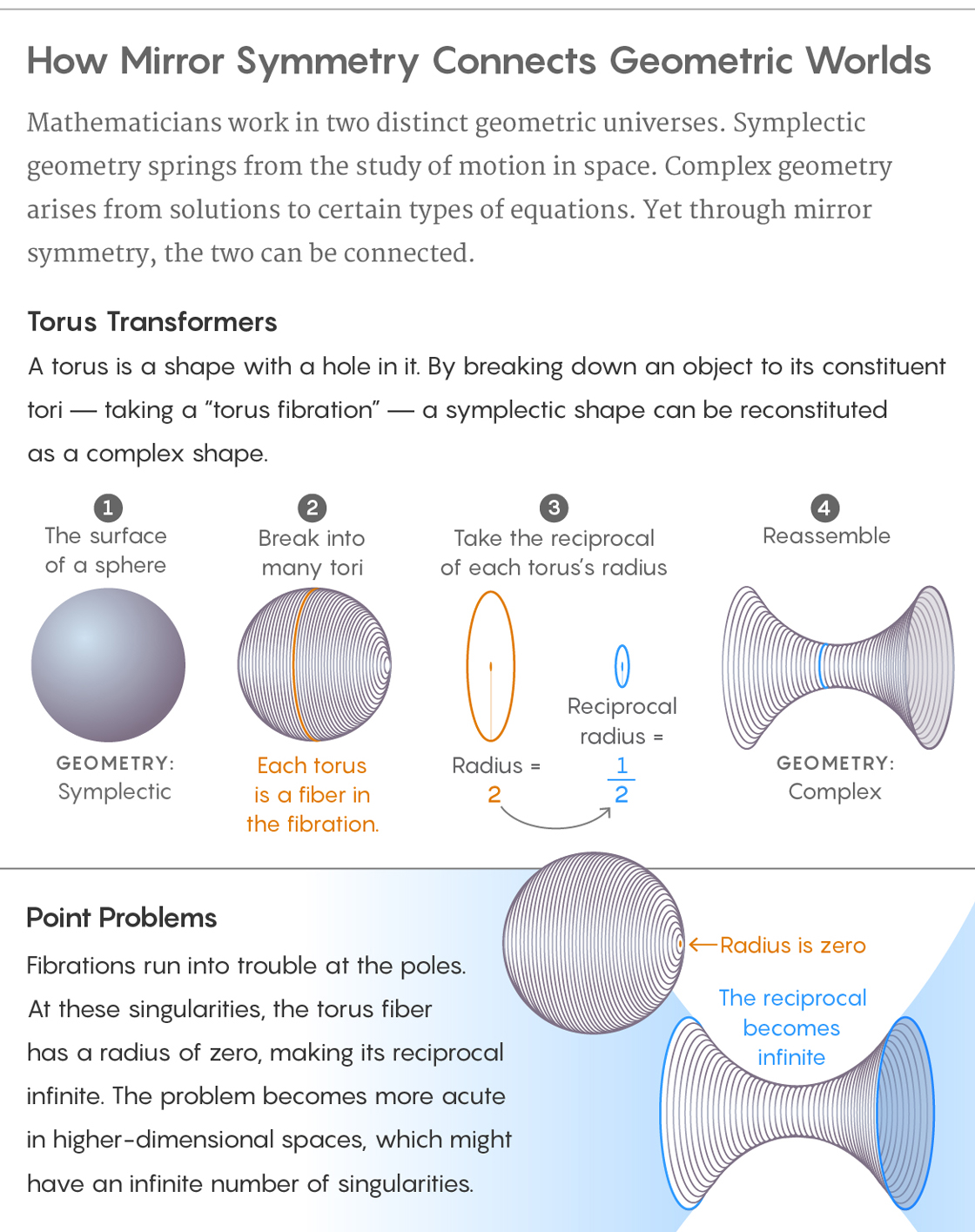
Here is the illustration of the concept provided by Quantum Magazine:


The Simple Explanation has always suggested that gravity is the force felt on the outside of ordinary objects due to presence of unseen toruses associated with ordinary matter. What the illustration refers to as “Point Problems” is actually the emergence of gravity. It seems to me that this symplectic geometry supplies a proof of this concept and, at the same time, resolves physic’s ongoing conundrum regarding the quantum level activity of black holes and the originating Bang.

We can imagine a very simple particle of matter as both that particle that we can see and measure and, at the same time, as a series of torus fibrations.  The fibrations at the poles with their infinite singularities originate the gravitational force, most of which occurs in alternate dimensions, but some of which “leaks” into our 3-D space. In the case of a small particle, the gravitational leakage is correspondingly small. But, when you aggregate particles into massive structures, the gravitational leakage becomes large and noticeable, as if the neighboring dimensions were trying to suck our space time into their dimensions.

The gravitational field around an object increases in proportion to the number of symplectic torus fibrations associated with the object’s ordinary matter. The reason gravity does not travel far from its originating object is because it is physically attached to the structure of the object—more precisely, to the toruses looping into neighboring dimensions. The more infinitely large singularities there are on the other side of the object’s multidimensional formula, the stronger the gravity of the object. The more aggregated ordinary matter, the more looping toruses.

In other words, gravity does not lead to black holes. Rather, massive objects produce so many toroidal fibrations of infinite singularities that the singularities themselves intrude into our 3-D space, revealing themselves and the toruses associated with them. When these singularities intrude into ordinary space, we see them in their normal symmetrical geometrical form as a single torus shape of infinite density and weight—a black hole.


Another conundrum standard physics is wrestling with has to do with “degrees of freedom.” Why, they wonder, do black holes have fewer degrees of freedom than ordinary objects? Meaning, why is their gravity only associated with the 2-dimensional outside surface of the black hole torus?

Since 2011, the Simple Explanation has suggested that gravity emanates from the exterior shell of the invisible torus wrapping around the exterior of ordinary matter.  In the case of a black hole, ordinary matter disappears into the center singularity, leaving only the shell of the symplectic torus to pull at space with its infinite gravitational shell, which is why the black hole’s gravity appears to be constrained  to the surface.

Top view of torus, with yellow arrows representing gravitational force


Side  view of torus, showing gravitational pull as well as material forces pushing out and wrapping around (white arrows)  From “Is Gravity a Toroidal Force?” 5-27-2011 Simple Explanation blog

I am grateful to Quantum Magazine for running these two recent articles on “Why Gravity Is Not Like the Other Forces” and “Mathematicians Explore Mirror Link Between Two Geometric Worlds.”  I believe “mirror symmetry” and the “SZY conjecture” provide the math behind the Simple Explanation’s theory of gravity. In symmetrical fashion, I hope my Simple Explanation will be discovered and considered by mathematicians and physicists struggling with these issues.

Friday, December 18, 2020

Reprint from Quanta Magazine: Mathematicians Explore Mirror Link Between Two Geometric Worlds

Here's a well-written article that explains how a toroidal universe is directly related to and mirrors our ordinary perceptions of space and geometry. In a nutshell, there are an infinite number of toruses associated with all ordinary geometric shapes. These toruses (aka tori) are situated in multi-dimensional space that is not perceived by our senses, but are nonetheless mathematically related to the objects that we can perceive. 

This newly discovered mathematical symmetry between ordinary perception and toroidal geometry fits in nicely with the Simple Explanation's model of toroidal realities. At this time, the mathematicians are able to make corresponding formulae that demonstrate the symmetry of these two vastly different geometries, but they are unable to explain the how or why. It is the how and why that the Simple Explanation cosmology provides, as yet undiscovered by conventional mathematicians and physicists. 

Curiously enough, this new symmetry is called the "SYZ conjecture" after the first initials of the 3-person team who discovered it, although the word "syzgy" means "yoked together," which is itself a highly appropriate title for this symmetrical geometry. Here's the reprinted article:

Quanta Magazine
Mirror_Symmetry_2880x1620.jpg

Credit: Mike Zeng for Quanta Magazine.

In 1991, a group of physicists made an accidental discovery that flipped mathematics on its head. The physicists were trying to work out the details of string theory when they observed a strange correspondence: Numbers emerging from one kind of geometric world matched exactly with very different kinds of numbers from a very different kind of geometric world.

To physicists, the correspondence was interesting. To mathematicians, it was preposterous. They’d been studying these two geometric settings in isolation from each other for decades. To claim that they were intimately related seemed as unlikely as asserting that at the moment an astronaut jumps on the moon, some hidden connection causes his sister to jump back on earth.

“It looked totally outrageous,” said David Morrison, a mathematician at the University of California, Santa Barbara, and one of the first mathematicians to investigate the matching numbers.

Nearly three decades later, incredulity has long since given way to revelation. The geometric relationship that the physicists first observed is the subject of one of the most flourishing fields in contemporary mathematics. The field is called mirror symmetry, in reference to the fact that these two seemingly distant mathematical universes appear somehow to reflect each other exactly. And since the observation of that first correspondence — a set of numbers on one side that matched a set of numbers on the other — mathematicians have found many more instances of an elaborate mirroring relationship: Not only do the astronaut and his sister jump together, they wave their hands and dream in unison, too.

Recently, the study of mirror symmetry has taken a new turn. After years of discovering more examples of the same underlying phenomenon, mathematicians are closing in on an explanation for why the phenomenon happens at all.

“We’re getting to the point where we’ve found the ground. There’s a landing in sight,” said Denis Auroux, a mathematician at the University of California, Berkeley.

The effort to come up with a fundamental explanation for mirror symmetry is being advanced by several groups of mathematicians. They are closing in on proofs of the central conjectures in the field. Their work is like uncovering a form of geometric DNA — a shared code that explains how two radically different geometric worlds could possibly hold traits in common.

Discovering the Mirror

What would eventually become the field of mirror symmetry began when physicists went looking for some extra dimensions. As far back as the late 1960s, physicists had tried to explain the existence of fundamental particles — electrons, photons, quarks — in terms of minuscule vibrating strings. By the 1980s, physicists understood that in order to make “string theory” work, the strings would have to exist in 10 dimensions — six more than the four-dimensional space-time we can observe. They proposed that what went on in those six unseen dimensions determined the observable properties of our physical world.

“You might have this small space that you can’t see or measure directly, but some aspects of the geometry of that space might influence real-world physics,” said Mark Gross, a mathematician at the University of Cambridge.

Eventually, they came up with potential descriptions of the six dimensions. Before getting to them, though, it’s worth thinking for a second about what it means for a space to have a geometry.

Consider a beehive and a skyscraper. Both are three-dimensional structures, but each has a very different geometry: Their layouts are different, the curvature of their exteriors is different, their interior angles are different. Similarly, string theorists came up with very different ways to imagine the missing six dimensions.

One method arose in the mathematical field of algebraic geometry. Here, mathematicians study polynomial equations — for example, x2 + y2 = 1 — by graphing their solutions (a circle, in this case). More-complicated equations can form elaborate geometric spaces. Mathematicians explore the properties of those spaces in order to better understand the original equations. Because mathematicians often use complex numbers, these spaces are commonly referred to as “complex” manifolds (or shapes).

The other type of geometric space was first constructed by thinking about physical systems such as orbiting planets. The coordinate values of each point in this kind of geometric space might specify, for example, a planet’s location and momentum. If you take all possible positions of a planet together with all possible momenta, you get the “phase space” of the planet — a geometric space whose points provide a complete description of the planet’s motion. This space has a “symplectic” structure that encodes the physical laws governing the planet’s motion.

Symplectic and complex geometries are as different from one another as beeswax and steel. They make very different kinds of spaces. Complex shapes have a very rigid structure. Think again of the circle. If you wiggle it even a little, it’s no longer a circle. It’s an entirely distinct shape that can’t be described by a polynomial equation. Symplectic geometry is much floppier. There, a circle and a circle with a little wiggle in it are almost the same.

“Algebraic geometry is a more rigid world, whereas symplectic geometry is more flexible,” said Nick Sheridan, a research fellow at Cambridge. “That’s one reason they’re such different worlds, and it’s so surprising they end up being equivalent in a deep sense.”

In the late 1980s, string theorists came up with two ways to describe the missing six dimensions: one derived from symplectic geometry, the other from complex geometry. They demonstrated that either type of space was consistent with the four-dimensional world they were trying to explain. Such a pairing is called a duality: Either one works, and there’s no test you could use to distinguish between them.

Physicists then began to explore just how far the duality extended. As they did so, they uncovered connections between the two kinds of spaces that grabbed the attention of mathematicians.

In 1991, a team of four physicists — Philip CandelasXenia de la Ossa, Paul Green and Linda Parkes — performed a calculation on the complex side and generated numbers that they used to make predictions about corresponding numbers on the symplectic side. The prediction had to do with the number of different types of curves that could be drawn in the six-dimensional symplectic space. Mathematicians had long struggled to count these curves. They had never considered that these counts of curves had anything to do with the calculations on complex spaces that physicists were now using in order to make their predictions.

The result was so far-fetched that at first, mathematicians didn’t know what to make of it. But then, in the months following a hastily convened meeting of physicists and mathematicians in Berkeley, California, in May 1991, the connection became irrefutable. “Eventually mathematicians worked on verifying the physicists’ predictions and realized this correspondence between these two worlds was a real thing that had gone unnoticed by mathematicians who had been studying the two sides of this mirror for centuries,” said Sheridan.

The discovery of this mirror duality meant that in short order, mathematicians studying these two kinds of geometric spaces had twice the number of tools at their disposal: Now they could use techniques from algebraic geometry to answer questions in symplectic geometry, and vice versa. They threw themselves into the work of exploiting the connection.

Breaking Up Is Hard to Do

At the same time, mathematicians and physicists set out to identify a common cause, or underlying geometric explanation, for the mirroring phenomenon. In the same way that we can now explain similarities between very different organisms through elements of a shared genetic code, mathematicians attempted to explain mirror symmetry by breaking down symplectic and complex manifolds into a shared set of basic elements called “torus fibers.”

A torus is a shape with a hole in the middle. An ordinary circle is a one-dimensional torus, and the surface of a donut is a two-dimensional torus. A torus can be of any number of dimensions. Glue lots of lower dimensional tori together in just the right way, and you can build a higher dimensional shape out of them.

To take a simple example, picture the surface of the earth. It is a two-dimensional sphere. You could also think of it as being made from many one-dimensional circles (like many lines of latitude) glued together. All these circles stuck together are a “torus fibration” of the sphere — the individual fibers woven together into a greater whole.

TorusFibration_560inline.jpg

Credit: Lucy Reading-Ikkanda / Quanta Magazine.

Torus fibrations are useful in a few ways. One is that they give mathematicians a simpler way to think of complicated spaces. Just like you can construct a torus fibration of a two-dimensional sphere, you can construct a torus fibration of the six-dimensional symplectic and complex spaces that feature in mirror symmetry. Instead of circles, the fibers of those spaces are three-dimensional tori. And while a six-dimensional symplectic manifold is impossible to visualize, a three-dimensional torus is almost tangible. “That’s already a big help,” said Sheridan.

A torus fibration is useful in another way: It reduces one mirror space to a set of building blocks that you could use to build the other. In other words, you can’t necessarily understand a dog by looking at a duck, but if you break each animal into its raw genetic code, you can look for similarities that might make it seem less surprising that both organisms have eyes.

Here, in a simplified view, is how to convert a symplectic space into its complex mirror. First, perform a torus fibration on the symplectic space. You’ll get a lot of tori. Each torus has a radius (just like a circle — a one-dimensional torus — has a radius). Next, take the reciprocal of the radius of each torus. (So, a torus of radius 4 in your symplectic space becomes a torus of radius ¼ in the complex mirror.) Then use these new tori, with reciprocal radii, to build a new space.

In 1996, Andrew StromingerShing-Tung Yau and Eric Zaslow proposed this method as a general approach for converting any symplectic space into its complex mirror. The proposal that it’s always possible to use a torus fibration to move from one side of the mirror to the other is called the SYZ conjecture, after its originators. Proving it has become one of the foundational questions in mirror symmetry (along with the homological mirror symmetry conjecture, proposed by Maxim Kontsevich in 1994).

The SYZ conjecture is hard to prove because, in practice, this procedure of creating a torus fibration and then taking reciprocals of the radii is not easy to do. To see why, return to the example of the surface of the earth. At first it seems easy to stripe it with circles, but at the poles, your circles will have a radius of zero. And the reciprocal of zero is infinity. “If your radius equals zero, you’ve got a bit of a problem,” said Sheridan.

This same difficulty crops up in a more pronounced way when you’re trying to create a torus fibration of a six-dimensional symplectic space. There, you might have infinitely many torus fibers where part of the fiber is pinched down to a point — points with a radius of zero. Mathematicians are still trying to figure out how to work with such fibers. “This torus fibration is really the great difficulty of mirror symmetry,” said Tony Pantev, a mathematician at the University of Pennsylvania.

Put another way: The SYZ conjecture says a torus fibration is the key link between symplectic and complex spaces, but in many cases, mathematicians don’t know how to perform the translation procedure that the conjecture prescribes.

Long-Hidden Connections

Over the past 27 years, mathematicians have found hundreds of millions of examples of mirror pairs: This symplectic manifold is in a mirror relationship with that complex manifold. But when it comes to understanding why a phenomenon occurs, quantity doesn’t matter. You could assemble an ark’s worth of mammals without coming any closer to understanding where hair comes from.

“We have huge numbers of examples, like 400 million examples. It’s not that there’s a lack of examples, but nevertheless it’s still specific cases that don’t give much of a hint as to why the whole story works,” said Gross.

Mathematicians would like to find a general method of construction — a process by which you could hand them any symplectic manifold and they could hand you back its mirror. And now they believe that they’re getting close to having it. “We’re moving past the case-by-case understanding of the phenomenon,” said Auroux. “We’re trying to prove that it works in as much generality as we can.”

Mathematicians are progressing along several interrelated fronts. After decades building up the field of mirror symmetry, they’re close to understanding the main reasons the field works at all.

“I think it will be done in a reasonable time,” said Kontsevich, a mathematician at the Institute of Advanced Scientific Studies (IHES) in France and a leader in the field. “I think it will be proven really soon.”

One active area of research creates an end run around the SYZ conjecture. It attempts to port geometric information from the symplectic side to the complex side without a complete torus fibration. In 2016, Gross and his longtime collaborator Bernd Siebert of the University of Hamburg posted a general-purpose method for doing so. They are now finishing a proof to establish that the method works for all mirror spaces. “The proof has now been completely written down, but it’s a mess,” said Gross, who said that he and Siebert hope to complete it by the end of the year.

Another major open line of research seeks to establish that, assuming you have a torus fibration, which gives you mirror spaces, then all the most important relationships of mirror symmetry fall out from there. The research program is called “family Floer theory” and is being developed by Mohammed Abouzaid, a mathematician at Columbia University. In March 2017 Abouzaid posted a paper that proved this chain of logic holds for certain types of mirror pairs, but not yet all of them.

And, finally, there is work that circles back to where the field began. A trio of mathematicians — Sheridan, Sheel Ganatra and Timothy Perutz — is building on seminal ideas introduced in 1990s by Kontsevich related to his homological mirror symmetry conjecture.

Cumulatively, these three initiatives would provide a potentially complete encapsulation of the mirror phenomenon. “I think we’re getting to the point where all the big ‘why’ questions are close to being understood,” said Auroux.

Kevin Hartnett is a senior writer at Quanta Magazine covering mathematics and computer science.