Showing posts with label Simple Explanation cosmology. Show all posts

Friday, December 18, 2020

Reprint from Quanta Magazine: Mathematicians Explore Mirror Link Between Two Geometric Worlds

Here's a well-written article that explains how a toroidal universe is directly related to and mirrors our ordinary perceptions of space and geometry. In a nutshell, there are an infinite number of toruses associated with all ordinary geometric shapes. These toruses (aka tori) are situated in multi-dimensional space that is not perceived by our senses, but are nonetheless mathematically related to the objects that we can perceive. 

This newly discovered mathematical symmetry between ordinary perception and toroidal geometry fits in nicely with the Simple Explanation's model of toroidal realities. At this time, the mathematicians are able to make corresponding formulae that demonstrate the symmetry of these two vastly different geometries, but they are unable to explain the how or why. It is the how and why that the Simple Explanation cosmology provides, as yet undiscovered by conventional mathematicians and physicists. 

Curiously enough, this new symmetry is called the "SYZ conjecture" after the first initials of the 3-person team who discovered it, although the word "syzgy" means "yoked together," which is itself a highly appropriate title for this symmetrical geometry. Here's the reprinted article:

Quanta Magazine
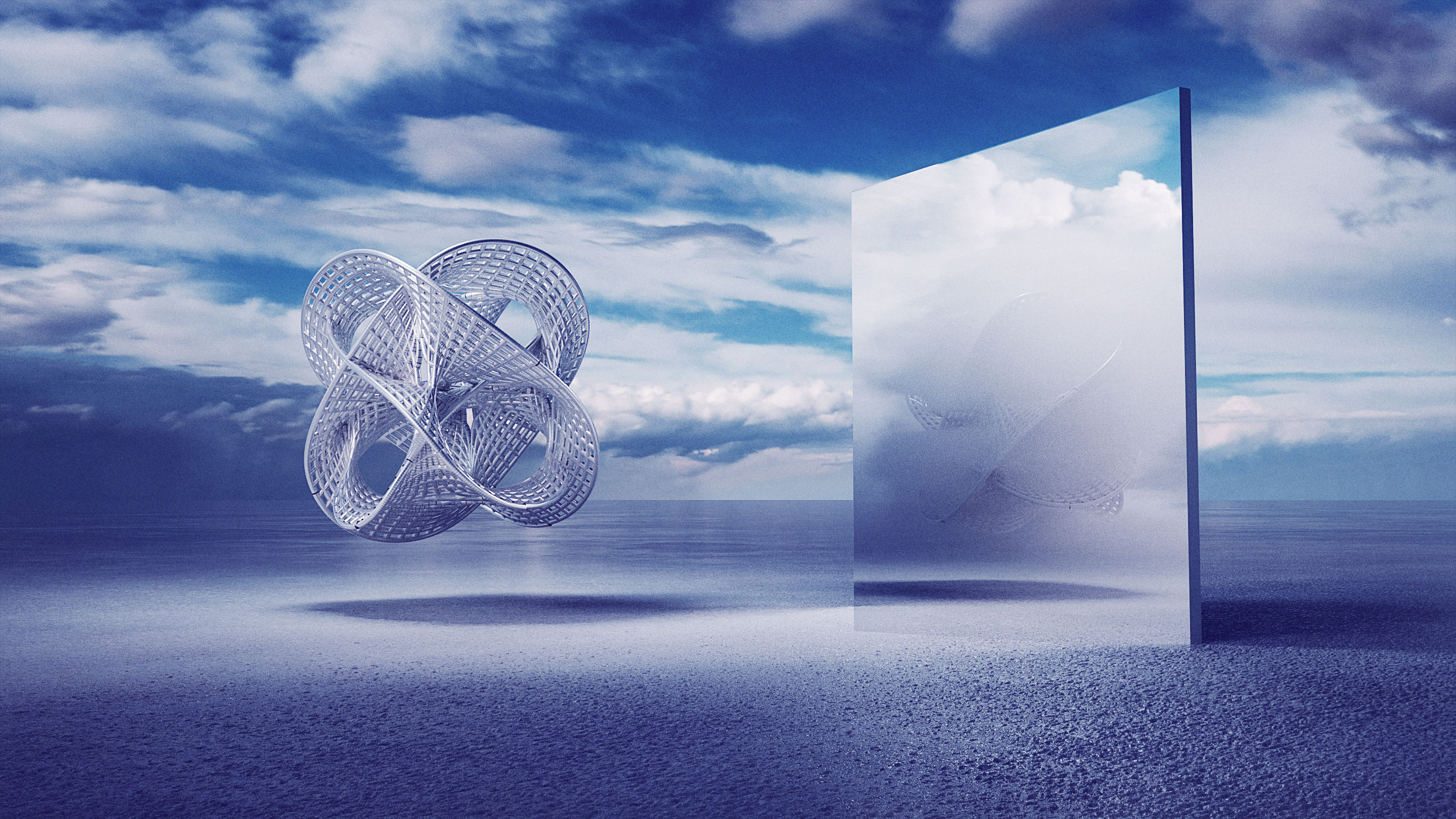
Mirror_Symmetry_2880x1620.jpg

Credit: Mike Zeng for Quanta Magazine.

In 1991, a group of physicists made an accidental discovery that flipped mathematics on its head. The physicists were trying to work out the details of string theory when they observed a strange correspondence: Numbers emerging from one kind of geometric world matched exactly with very different kinds of numbers from a very different kind of geometric world.

To physicists, the correspondence was interesting. To mathematicians, it was preposterous. They’d been studying these two geometric settings in isolation from each other for decades. To claim that they were intimately related seemed as unlikely as asserting that at the moment an astronaut jumps on the moon, some hidden connection causes his sister to jump back on earth.

“It looked totally outrageous,” said David Morrison, a mathematician at the University of California, Santa Barbara, and one of the first mathematicians to investigate the matching numbers.

Nearly three decades later, incredulity has long since given way to revelation. The geometric relationship that the physicists first observed is the subject of one of the most flourishing fields in contemporary mathematics. The field is called mirror symmetry, in reference to the fact that these two seemingly distant mathematical universes appear somehow to reflect each other exactly. And since the observation of that first correspondence — a set of numbers on one side that matched a set of numbers on the other — mathematicians have found many more instances of an elaborate mirroring relationship: Not only do the astronaut and his sister jump together, they wave their hands and dream in unison, too.

Recently, the study of mirror symmetry has taken a new turn. After years of discovering more examples of the same underlying phenomenon, mathematicians are closing in on an explanation for why the phenomenon happens at all.

“We’re getting to the point where we’ve found the ground. There’s a landing in sight,” said Denis Auroux, a mathematician at the University of California, Berkeley.

The effort to come up with a fundamental explanation for mirror symmetry is being advanced by several groups of mathematicians. They are closing in on proofs of the central conjectures in the field. Their work is like uncovering a form of geometric DNA — a shared code that explains how two radically different geometric worlds could possibly hold traits in common.

Discovering the Mirror

What would eventually become the field of mirror symmetry began when physicists went looking for some extra dimensions. As far back as the late 1960s, physicists had tried to explain the existence of fundamental particles — electrons, photons, quarks — in terms of minuscule vibrating strings. By the 1980s, physicists understood that in order to make “string theory” work, the strings would have to exist in 10 dimensions — six more than the four-dimensional space-time we can observe. They proposed that what went on in those six unseen dimensions determined the observable properties of our physical world.

“You might have this small space that you can’t see or measure directly, but some aspects of the geometry of that space might influence real-world physics,” said Mark Gross, a mathematician at the University of Cambridge.

Eventually, they came up with potential descriptions of the six dimensions. Before getting to them, though, it’s worth thinking for a second about what it means for a space to have a geometry.

Consider a beehive and a skyscraper. Both are three-dimensional structures, but each has a very different geometry: Their layouts are different, the curvature of their exteriors is different, their interior angles are different. Similarly, string theorists came up with very different ways to imagine the missing six dimensions.

One method arose in the mathematical field of algebraic geometry. Here, mathematicians study polynomial equations — for example, x2 + y2 = 1 — by graphing their solutions (a circle, in this case). More-complicated equations can form elaborate geometric spaces. Mathematicians explore the properties of those spaces in order to better understand the original equations. Because mathematicians often use complex numbers, these spaces are commonly referred to as “complex” manifolds (or shapes).

The other type of geometric space was first constructed by thinking about physical systems such as orbiting planets. The coordinate values of each point in this kind of geometric space might specify, for example, a planet’s location and momentum. If you take all possible positions of a planet together with all possible momenta, you get the “phase space” of the planet — a geometric space whose points provide a complete description of the planet’s motion. This space has a “symplectic” structure that encodes the physical laws governing the planet’s motion.

Symplectic and complex geometries are as different from one another as beeswax and steel. They make very different kinds of spaces. Complex shapes have a very rigid structure. Think again of the circle. If you wiggle it even a little, it’s no longer a circle. It’s an entirely distinct shape that can’t be described by a polynomial equation. Symplectic geometry is much floppier. There, a circle and a circle with a little wiggle in it are almost the same.

“Algebraic geometry is a more rigid world, whereas symplectic geometry is more flexible,” said Nick Sheridan, a research fellow at Cambridge. “That’s one reason they’re such different worlds, and it’s so surprising they end up being equivalent in a deep sense.”

In the late 1980s, string theorists came up with two ways to describe the missing six dimensions: one derived from symplectic geometry, the other from complex geometry. They demonstrated that either type of space was consistent with the four-dimensional world they were trying to explain. Such a pairing is called a duality: Either one works, and there’s no test you could use to distinguish between them.

Physicists then began to explore just how far the duality extended. As they did so, they uncovered connections between the two kinds of spaces that grabbed the attention of mathematicians.

In 1991, a team of four physicists — Philip CandelasXenia de la Ossa, Paul Green and Linda Parkes — performed a calculation on the complex side and generated numbers that they used to make predictions about corresponding numbers on the symplectic side. The prediction had to do with the number of different types of curves that could be drawn in the six-dimensional symplectic space. Mathematicians had long struggled to count these curves. They had never considered that these counts of curves had anything to do with the calculations on complex spaces that physicists were now using in order to make their predictions.

The result was so far-fetched that at first, mathematicians didn’t know what to make of it. But then, in the months following a hastily convened meeting of physicists and mathematicians in Berkeley, California, in May 1991, the connection became irrefutable. “Eventually mathematicians worked on verifying the physicists’ predictions and realized this correspondence between these two worlds was a real thing that had gone unnoticed by mathematicians who had been studying the two sides of this mirror for centuries,” said Sheridan.

The discovery of this mirror duality meant that in short order, mathematicians studying these two kinds of geometric spaces had twice the number of tools at their disposal: Now they could use techniques from algebraic geometry to answer questions in symplectic geometry, and vice versa. They threw themselves into the work of exploiting the connection.

Breaking Up Is Hard to Do

At the same time, mathematicians and physicists set out to identify a common cause, or underlying geometric explanation, for the mirroring phenomenon. In the same way that we can now explain similarities between very different organisms through elements of a shared genetic code, mathematicians attempted to explain mirror symmetry by breaking down symplectic and complex manifolds into a shared set of basic elements called “torus fibers.”

A torus is a shape with a hole in the middle. An ordinary circle is a one-dimensional torus, and the surface of a donut is a two-dimensional torus. A torus can be of any number of dimensions. Glue lots of lower dimensional tori together in just the right way, and you can build a higher dimensional shape out of them.

To take a simple example, picture the surface of the earth. It is a two-dimensional sphere. You could also think of it as being made from many one-dimensional circles (like many lines of latitude) glued together. All these circles stuck together are a “torus fibration” of the sphere — the individual fibers woven together into a greater whole.
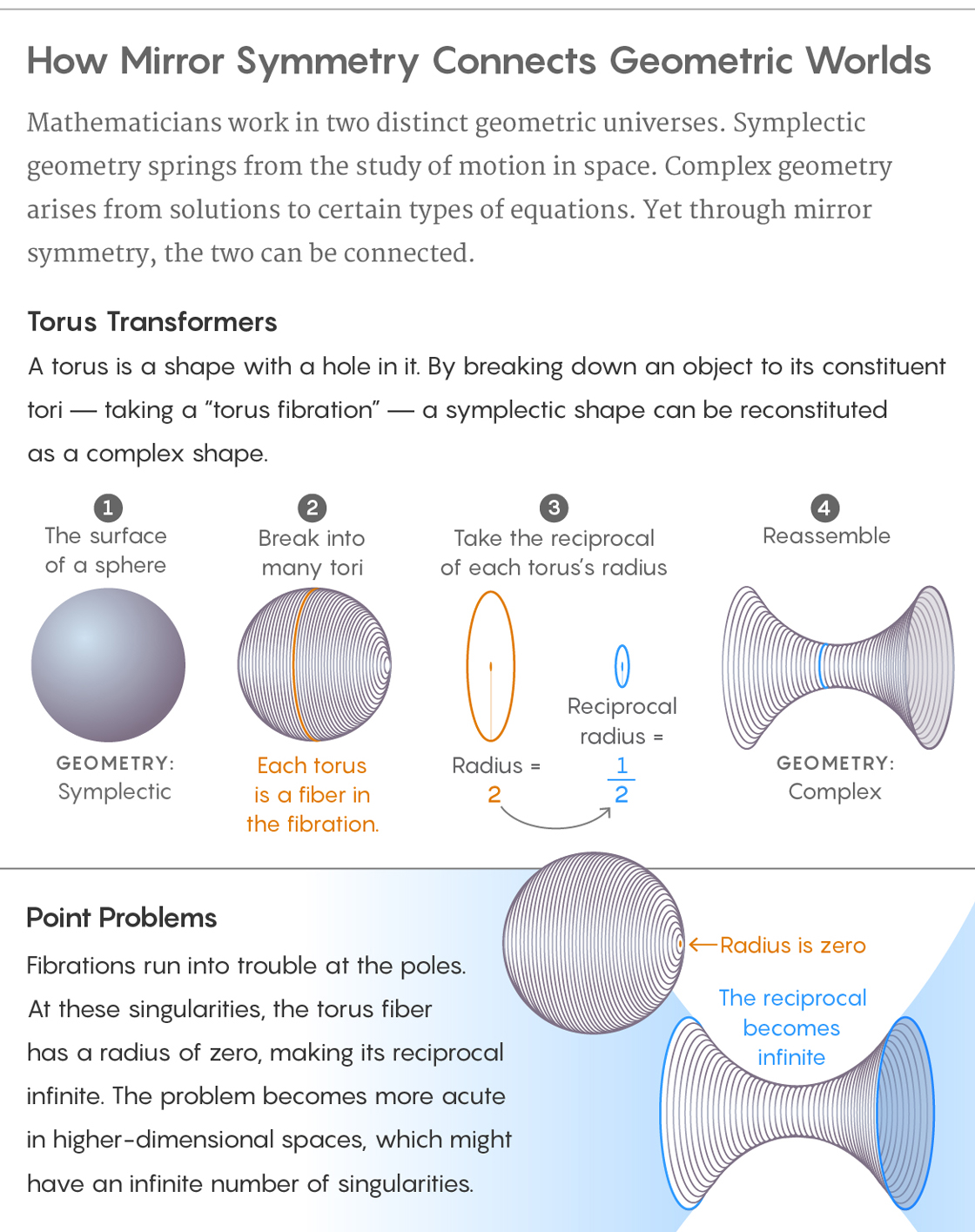
TorusFibration_560inline.jpg

Credit: Lucy Reading-Ikkanda / Quanta Magazine.

Torus fibrations are useful in a few ways. One is that they give mathematicians a simpler way to think of complicated spaces. Just like you can construct a torus fibration of a two-dimensional sphere, you can construct a torus fibration of the six-dimensional symplectic and complex spaces that feature in mirror symmetry. Instead of circles, the fibers of those spaces are three-dimensional tori. And while a six-dimensional symplectic manifold is impossible to visualize, a three-dimensional torus is almost tangible. “That’s already a big help,” said Sheridan.

A torus fibration is useful in another way: It reduces one mirror space to a set of building blocks that you could use to build the other. In other words, you can’t necessarily understand a dog by looking at a duck, but if you break each animal into its raw genetic code, you can look for similarities that might make it seem less surprising that both organisms have eyes.

Here, in a simplified view, is how to convert a symplectic space into its complex mirror. First, perform a torus fibration on the symplectic space. You’ll get a lot of tori. Each torus has a radius (just like a circle — a one-dimensional torus — has a radius). Next, take the reciprocal of the radius of each torus. (So, a torus of radius 4 in your symplectic space becomes a torus of radius ¼ in the complex mirror.) Then use these new tori, with reciprocal radii, to build a new space.

In 1996, Andrew StromingerShing-Tung Yau and Eric Zaslow proposed this method as a general approach for converting any symplectic space into its complex mirror. The proposal that it’s always possible to use a torus fibration to move from one side of the mirror to the other is called the SYZ conjecture, after its originators. Proving it has become one of the foundational questions in mirror symmetry (along with the homological mirror symmetry conjecture, proposed by Maxim Kontsevich in 1994).

The SYZ conjecture is hard to prove because, in practice, this procedure of creating a torus fibration and then taking reciprocals of the radii is not easy to do. To see why, return to the example of the surface of the earth. At first it seems easy to stripe it with circles, but at the poles, your circles will have a radius of zero. And the reciprocal of zero is infinity. “If your radius equals zero, you’ve got a bit of a problem,” said Sheridan.

This same difficulty crops up in a more pronounced way when you’re trying to create a torus fibration of a six-dimensional symplectic space. There, you might have infinitely many torus fibers where part of the fiber is pinched down to a point — points with a radius of zero. Mathematicians are still trying to figure out how to work with such fibers. “This torus fibration is really the great difficulty of mirror symmetry,” said Tony Pantev, a mathematician at the University of Pennsylvania.

Put another way: The SYZ conjecture says a torus fibration is the key link between symplectic and complex spaces, but in many cases, mathematicians don’t know how to perform the translation procedure that the conjecture prescribes.

Long-Hidden Connections

Over the past 27 years, mathematicians have found hundreds of millions of examples of mirror pairs: This symplectic manifold is in a mirror relationship with that complex manifold. But when it comes to understanding why a phenomenon occurs, quantity doesn’t matter. You could assemble an ark’s worth of mammals without coming any closer to understanding where hair comes from.

“We have huge numbers of examples, like 400 million examples. It’s not that there’s a lack of examples, but nevertheless it’s still specific cases that don’t give much of a hint as to why the whole story works,” said Gross.

Mathematicians would like to find a general method of construction — a process by which you could hand them any symplectic manifold and they could hand you back its mirror. And now they believe that they’re getting close to having it. “We’re moving past the case-by-case understanding of the phenomenon,” said Auroux. “We’re trying to prove that it works in as much generality as we can.”

Mathematicians are progressing along several interrelated fronts. After decades building up the field of mirror symmetry, they’re close to understanding the main reasons the field works at all.

“I think it will be done in a reasonable time,” said Kontsevich, a mathematician at the Institute of Advanced Scientific Studies (IHES) in France and a leader in the field. “I think it will be proven really soon.”

One active area of research creates an end run around the SYZ conjecture. It attempts to port geometric information from the symplectic side to the complex side without a complete torus fibration. In 2016, Gross and his longtime collaborator Bernd Siebert of the University of Hamburg posted a general-purpose method for doing so. They are now finishing a proof to establish that the method works for all mirror spaces. “The proof has now been completely written down, but it’s a mess,” said Gross, who said that he and Siebert hope to complete it by the end of the year.

Another major open line of research seeks to establish that, assuming you have a torus fibration, which gives you mirror spaces, then all the most important relationships of mirror symmetry fall out from there. The research program is called “family Floer theory” and is being developed by Mohammed Abouzaid, a mathematician at Columbia University. In March 2017 Abouzaid posted a paper that proved this chain of logic holds for certain types of mirror pairs, but not yet all of them.

And, finally, there is work that circles back to where the field began. A trio of mathematicians — Sheridan, Sheel Ganatra and Timothy Perutz — is building on seminal ideas introduced in 1990s by Kontsevich related to his homological mirror symmetry conjecture.

Cumulatively, these three initiatives would provide a potentially complete encapsulation of the mirror phenomenon. “I think we’re getting to the point where all the big ‘why’ questions are close to being understood,” said Auroux.

Kevin Hartnett is a senior writer at Quanta Magazine covering mathematics and computer science.

Thursday, March 26, 2020

Fertilized Eggs and Our Expanding Universe--Same Swirling Pattern

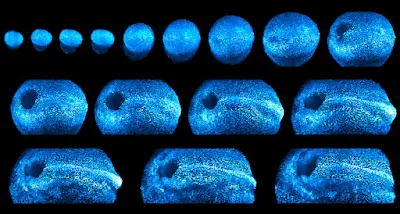
Take a look at the this mind-blowing image of a newly fertilized egg kicking out spiraling patterns of proteins as it prepares to undergo its first cell division. 


Fertilized egg manifests spiraling patterns prior to first division.
https://news.mit.edu/2020/growth-organism-waves-0323
MIT researchers were surprised to discover that the swirling patterns precisely mirror other systems, from atmospheric hurricanes to ocean circulation hydrodynamics to quantum fluids. 

As you can see, the swirling patterns emanate from a central interior position and spread over the surface of the egg. You can also see the depression on the far side of the egg begin to appear as it prepares to sink inward toward the middle, where it will eventually form the hollow tube of the organism's gut.

In 2018 I wrote an article called "A Simple Explanation of an Embryo's Development--It's a Torus!"  Here's an image from that article, which demonstrates the next stages in the zygote's life. I urge you to read that article for a description of the developing toroidal embryo.

These images track a mouse embryo from gastrulation through organogenesis.
K. McDole et.al. Cell/2018
 VOLUME 175, ISSUE 3P859-876.E33, OCTOBER 18, 2018
"each wave emerged in a spiral pattern, and that multiple spirals whirled across an egg’s surface at a time. Some spirals spontaneously appeared and swirled away in opposite directions, while others collided head-on and immediately disappeared.
"The behavior of these swirling waves, the researchers realized, is similar to the waves generated in other, seemingly unrelated systems, such as the vortices in quantum fluids, the circulations in the atmosphere and oceans, and the electrical signals that propagate through the heart and brain.
“Not much was known about the dynamics of these surface waves in eggs, and after we started analyzing and modeling these waves, we found these same patterns show up in all these other systems,” says physicist Nikta Fakhri, the Thomas D. and Virginia W. Cabot Assistant Professor at MIT. “It’s a manifestation of this very universal wave pattern.”
The research further states, 
"From their videos, the team observed that waves seemed to oscillate outward as tiny, hurricane-like spirals. The researchers traced the origin of each wave to the core of each spiral, which they refer to as a “topological defect.” Out of curiosity, they tracked the movement of these defects themselves. They did some statistical analysis to determine how fast certain defects moved across an egg’s surface, and how often, and in what configurations the spirals popped up, collided, and disappeared.
"In a surprising twist, they found that their statistical results, and the behavior of waves in an egg’s surface, were the same as the behavior of waves in other larger and seemingly unrelated systems.
“When you look at the statistics of these defects, it’s essentially the same as vortices in a fluid, or waves in the brain, or systems on a larger scale,” Dunkel says. “It’s the same universal phenomenon, just scaled down to the level of a cell.”
At some point in human research efforts, the inevitability of the principle called "as above, so below" emerges clear as day. It's wonderful to see an MIT study acknowledge this.  Putting this new finding together with my previous article on the toroidal nature of embryo development, we can see further proof of the Simple Explanation's overarching torus theory.
Moving on, today I ran across another study by Kanazawa University researcher Nobyoshi Komatsu on "Horizon Thermodynamics in holographic cosmological models."  The title of this study made me think about the outer horizon of our universe and the patterns found there. Putting two and two together makes me wonder if the patterns of early galactic swirls aren't the same phenomena as the patterns of swirling proteins. I'm guessing they are.  If this proves to be true, then it will point to a torus as the shape of the Big Bang and our universal topology--the cosmic egg. Another Simple Explanation prediction waiting to be proven by science...
NASA news
Galaxies of Stephan's Quintet in the constellation of Pegasus, observed by the NASA/ESA Hubble Space Telescope. Image credit: NASA, ESA, and the Hubble SM4 ERO Team.

Tuesday, November 12, 2019

Super Massive Structures Tie the Universe Together--Toruses!

The latest discoveries in astronomy continue to uphold the Simple Explanation theory that the universe is comprised of patterns of toroidal energy. For about ten years now, I have been suggesting here on this blog that there are toruses large and small throughout the cosmos. 
 wireframe torus shape with zero point middle
Wireframe Torus with Zero Point Center
At large and small scales, these "donuts" or "halos" or "bubbles" produce energy out of their middles, ejecting forces into the space around them and pulling forces back into the black holes at their zero-point centers.
Toroidal forces and flows


When the torus is small, it governs atomic forces, including electromagnetic energy and gravity.

When the torus is large, it both gathers and feeds large astronomical structures with the same electromagnetic forces and gravity.

The "bubbles" and "halos" show where the torus is
Much to my delight, the very latest discoveries that are shaking up the standard cosmological models continue to uphold and strengthen this theory.

Today's article was prompted by the discovery of super-massive structures that appear to tie the entire universe together. Scientists do not know how, but they now must admit that the data shows that a jiggle on one side of the universe causes a corresponding jiggle somewhere else in the universe, as if they were somehow connected by gigantic invisible filaments. 

A series of articles in Vice by science writer Becky Ferreira clearly outlines numerous puzzling phenomena--from super-massive universal structures and energetic galactic bubbles, to the increasing possibility of a closed, spherical universal space as opposed to the standard model of a flat, infinite space. Scientist are both baffled and challenged as they attempt to find a cosmic model to account for these new observations. 

The clues to the solution are already imbedded in the language used to describe their findings, for they all refer to "bubbles," "spheres," "balloons," and "halos." These are other words for the torus shape and dynamics.

All of these puzzles can be explained by picturing the universe as a closed, toroidal system, with a super-massive torus sitting at both the center and enveloping all of space at its outside boundary. Moreover, this super-massive torus has been slowly growing larger (the expanding universe) as energetic forces continue to enter space from the middle. In my Simple Explanation, the big bang occurred at the center of an outflowing black hole, which continues to push matter outward into the closed space of the growing torus that surrounds it.

My theory also suggests the presence of miniscule toruses seeded throughout space, bringing energy and anti-entropic organization at the tiny atomic level.

Whether tiny or gigantic, the toruses look the same and perform the same functions, just at smaller and larger scales.

If you would like to picture this and demonstrate the forces for yourself, you may take an ordinary slinky toy and fasten its two ends into the donut shape of a torus. You will find that when you touch any part of the slinky-torus, the entire structure jiggles. If you push on any wire in the slinky-torus so that it rotates toward the center, the entire slinky-torus rotates toward the center. 
In this slinky-donut model, if you push a wire downward into the center hole, all wires push downward into the center hole, making an inflow of energy, as in a black hole. This inflow direction is the energetic basis of gravity. From the bottom side of this experiment, the wires flow outward and back around the outside of the torus to the top. This outflow direction is the manner by which electromagnetic and other energetic forces are pushed into this universe. The outflow direction is organizational, informative, and anti-entropic. Scale is irrelevant; they are all the same torus. 

You may read my entire series of 30+ toroidal articles by going to the "Topical Index" tab on the Simple Explanation blog and finding the "Toroidal Forces" section. 

You're welcome.
***********************

Here are links to four of Ferreira's articles on this subject: 

There’s Growing Evidence That the Universe Is Connected by Giant Structures


Scientists are finding that galaxies can move with each other across huge distances, and against the predictions of basic cosmological models. The reason why could change everything we think we know about the universe.

Tuesday, October 1, 2019

Quantum Foam Smothers Huge Amounts of Energy--Reprint and Commentary

According to my interpretation of gnostic cosmology, quantum foam emerged as the first material expression after the Fall. In the pre-Fall state, consciousness was immaterial and purely ephemeral. After the Fall, consciousness expressed itself as a slower, denser, and more concrete form. 

Both the Simple Explanation cosmology and the gnostic cosmology speak of the emergence of ordinary matter as arising from the small, uncooperative first expressions of random behavior--i.e. quantum foam. Quantum foam is entirely unpredictable and chaotic. This chaos effectively uses up and partially smothers the infinity of coherent consciousness underlying and preceding the foam, like a blanket thrown over a fire.  The random nature of quantum foam explains "free will" in our material universe, as the quantum randomness forms the platform underlying ordinary matter, occasionally interjecting itself into a material cosmos otherwise rigidly constrained by cause and effect.
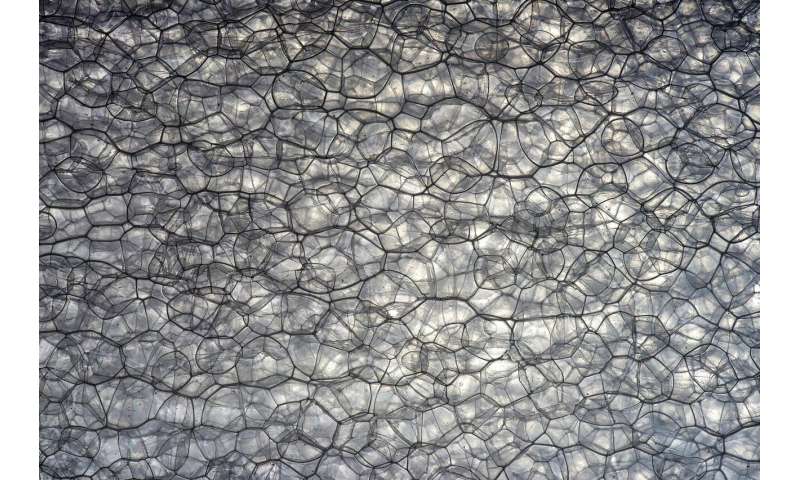
This illustration, borrowed from Brian Greene's The Elegant Universe, shows how the appearance of matter transforms from smooth to chaotic the closer you look. Imagine the ordinary, unmagnified, world as the grid at the bottom of the drawing, and that each successive plane represents a closer look at a portion of the plane below.  At the most extreme ultra-magnification, quantum fluctuations have replaced smooth, predictable geometry.
This model of chaos can be used to illustrate the principle of individual free will. As was previously stated in Traits of Units of Consciousness,  most Units of Consciousness perform as expected—they “do their part,” they “work according to plan.” It was also stated that every UC has the free will to fulfill or contradict its responsibilities.

Below you will find a new scientific article that explains quantum foam with a new hypothesis that I find compatible with my cosmologies.


Physicist suggests 'quantum foam' may explain away huge cosmic energy

foam
Credit: CC0 Public Domain
Steven Carlip, a physicist at the University of California, has come up with a theory to explain why empty space seems to be filled with a huge amount of energy—it may be hidden by effects that are canceling it out at the Planck scale. He has published a paper describing his new theory in the journal Physical Review Letters.
Conventional theory suggests that  should be filled with a huge amount of energy—perhaps as much as 10120 more than seemingly exists. Over the years, many theorists have suggested ideas on why this may be—most have tried the obvious approach, trying to figure out a way to make the energy go away. But none have been successful. In this new effort, Carlip suggests that maybe all that energy really is there, but it does not have any ties to the expansion of the universe because its effects are being canceled out by something at the Planck scale.
The new  by Carlip is based very heavily on work done by John Wheeler back in the 1950s—he suggested that at the smallest possible scale, space and time turn into something he called "spacetime foam." He argued that at such a small scale, defining time, length and energy would be subject to the uncertainty principle. Since then, others have taken a serious look at spacetime foam—and some have suggested that if a vacuum were filled with spacetime foam, there would be a lot of energy involved. Others argue that such a scenario would behave like the cosmological constant.
Thus, to explain their ideas, they have sought to find ways to cancel out the energy as a way to make it go away. Carlip suggests instead that in a spacetime foam scenario,  would exist everywhere in a vacuum—but if you took a much closer look, you would find Planck-sized areas that have an equal likelihood of expanding or contracting. And under such a scenario, the patchwork of tiny areas would appear the same as larger areas in the —and they would not expand or contract, which means they would have a zero cosmic constant. He notes that under such a scenario, time would have no intrinsic direction.
More information: S. Carlip. Hiding the Cosmological Constant, Physical Review Letters (2019). DOI: 10.1103/PhysRevLett.123.131302 . On Arxiv: https://arxiv.org/abs/1809.08277
Journal information: Physical Review Letters , arXiv 

Monday, July 2, 2018

First confirmed image of the birth of a planet--arising from a torus!

In the article below, scientists refer to the torus around the baby planet's home star as a "proto-planetary disk."  You will recognize the familiar pattern as what the Simple Explanation calls a "proto-torus." 
This is the first clear image of a planet caught in the act of formation around the dwarf star PDS 70.
It's always fun for me to see scientists run across new toroidal patterns, as each instance confirms my hypothesis that the basic material in our universe arises out of toroidal energetic patterns aggregating into material form. In this case, the energetic material is likely growing out of the center of the proto-disk and aggregating into this new planet rather than the other way around--it is not merely matter trapped by the sun.

Here is a reprint of the July 2, 2018 CNN article by Ashley Strickland, announcing the new planet:

A planet-hunting instrument has captured the first confirmed image of a newborn planet that's still forming in our galaxy.
To the right of the black circle at the center of the image, the round bright planet can be seen within the disk of gas and dust around the young dwarf star PDS 70. Of course, the center isn't naturally this dark. Instead, the researchers used a coronagraph to block the bright light of the star in order to look at the disk and the planet.

It's carving out a path through the disk around the star, which is in the Centaurus constellation. The protoplanetary disk is the "planet factory" full of gas and dust around young stars. The planet was found in a gap in this disk, which means it is close to where it was born and still growing by accumulating material from the disk.

The planet, dubbed PDS 70b, was detected by an international team using the European Southern Observatory's Very Large Telescope in Chile and its planet-hunting instrument, called SPHERE. The instrument is considered to be one of the most powerful planet hunters in existence.

The discovery by two teams of researchers is detailed in two papers published in the journal Astronomy & Astrophysics on Monday.


"These discs around young stars are the birthplaces of planets, but so far only a handful of observations have detected hints of baby planets in them," Miriam Keppler of the Max Planck Institute for Astronomy, who led one team, said in a statement. "The problem is that until now, most of these planet candidates could just have been features in the disc."

André Müller, also with the Max Planck institute and leader of the second team, said in a statement that "Keppler's results give us a new window onto the complex and poorly-understood early stages of planetary evolution. We needed to observe a planet in a young star's disc to really understand the processes behind planet formation."

SPHERE was able to measure the planet's brightness at different wavelengths, which enabled the researchers to determine the properties of its atmosphere.

This is incredibly challenging, because even though SPHERE used the coronagraph to block the star, it had to seek out the planet's signal in multiple ways.

Researchers were able to determine that it's a giant gas planet and has a blisteringly hot surface temperature of 1,832 degrees Fahrenheit. This is at least a few times the mass of Jupiter, the largest gas giant in our solar system, and well above the highest temperature recorded on any planet in our solar system.

They also deduced that it has a cloudy atmosphere.

Although the planet looks close to its star in the image, it's 1,864,113,576 miles away. That's the same distance as Uranus from our sun. It takes the planet 120 years to orbit the star, which fits with astronomers' predictions that gas giants would need to form quite far from their stars.

Directly imaging the planet is a game-changer. Going forward, researchers will be able test models of how planets form and learn more about the history of how the earliest planetary systems formed, like our own solar system.

"After more than a decade of enormous efforts to build this high-tech machine, now SPHERE enables us to reap the harvest with the discovery of baby planets!" Thomas Henning, director at the Max Planck Institute for Astronomy and leader of the teams, said in a statement.

**********************************************


Proto-torus shape. Energy from the middle; containment from the boundary. Chalk drawing by Cyd Ropp.